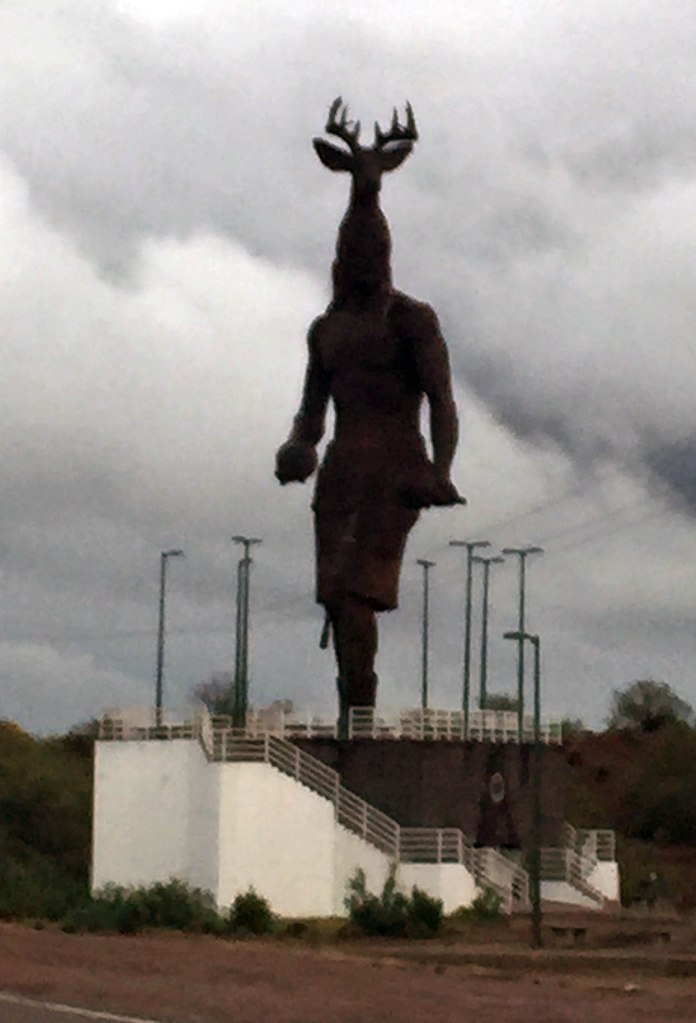
The main drag through Navojoa was a whole lot quieter on a Monday afternoon than it had been on Friday evening, and so was the concrete freeway heading north. The 100-foot statue of the Yaqui warrior with his buck’s-head headdress, dancing in place beside the Obregon bypass route, looked considerably less ominous under a sunny sky.
With more time to spare, we might have spent a day exploring the bay area of Guaymas, where I’d never been. In any case, the electronic road map routed us wide to the north of the city on our way to San Carlos.
Fish out of water
The boulevard leading through the resort town seemed all but dead considering that this should have been a high mark of the winter season, just before New Year’s. Some of the lodgings we checked didn’t even seem to be open for business, so we headed on through and around the spectacular bay, with its high barren cliffs. Farther around the peninsula, the resorts are increasingly exclusive, the gated clubs more ensconced. Eventually, we headed back, hoping to catch the sunset at the Mirador.
It turned out that whatever population was on hand had the same idea, and we had to find a parking spot several hairpin turns shy of the overlook. Clearly, this was the heart of the local social scene, with extended families in Sunday best drifting across the expanse of brickwork, cute couples and BFFs snapping selfies along the railing, the cliffs aflame behind them in staggered outcroppings along the coast.
Our hunger trumping our fatigue, we gravitated toward Tortuga’s, looming above the main intersection on the way back into town, where the seafood meal indeed matched the almost-five-star ranking. The proprietor sensing that we were in search of lodgings, recommended a place in the marina district below, owned by a friend of his, and even called ahead for us.
She met us there and let us into the motel room, spartan if clean, then promptly disappeared. We were, after all, her only guests. We didn’t mind that there was no heat on the chilly night, or even hot water. But when we realized how thin the blanket on the bed was, we had to go all the way back up to the Tortuga to get the owner’s number. We’re used to wilderness camping in freezing temperatures, but even we have our limit, especially when we’re paying resort rates.
Not quite ready to settle into those spare accommodations, we headed out to what appeared to be the only nearby nightlife, the Captain’s Club, a rustic place clearly catering to expats and long-term residents from the north – with classic bar food on the laminated menu and oldie favorites seeping from the PA. They did in fact serve a tasty albondigas soup, a sinus-clearing antidote to the night chill, which we somehow polished off on top of our earlier seafood feast.
Branching off
After eggs and too much coffee at a justly crowded breakfast joint on the strip, we were again heading north on Hwy 15, with its intermittent toll booths surrounded by dusty ejidos that seemed to exist only as bases for the swarms of preteens who clustered around the speed humps to coax coins from travelers into decapitated plastic jugs.
The cutoff we were looking for was a two-lane that teed into the highway from the west. When we found it, we weren’t sure it was still in use, since the incoming lane was blocked. Just outside the mound of dirt, a federal policeman appeared to be wrapping up his cross-examination of a young man who evidently had just come from that direction, so we decided to ask whether the road was open and whether it was free of scoundrels.
I could see the cop’s mind working, plotting the tortuous course to an eventual bribe, a “special favor” he would grant in letting us continue on our way. Thankfully, he was overcome by the temptation to continue bullying the young man, whom he called back over to ask whether the road he had just come down was safe for travelers. Though the kid looked like he was about to wet his pants, I was shamefully grateful to have him for a scapegoat. As we drove away, we decided we probably had more to worry about from the cop than from bandits. If there was in fact a difference.
This side route cuts across the northern edge of a wildlife preserve by the name of Devil’s Canyon. Normally, the lush mountains to the south would have been an irresistible lure to us, but we had a 400-mile drive ahead of us along a very uncertain route, with whatever unplanned stops along the way.
Old haunts
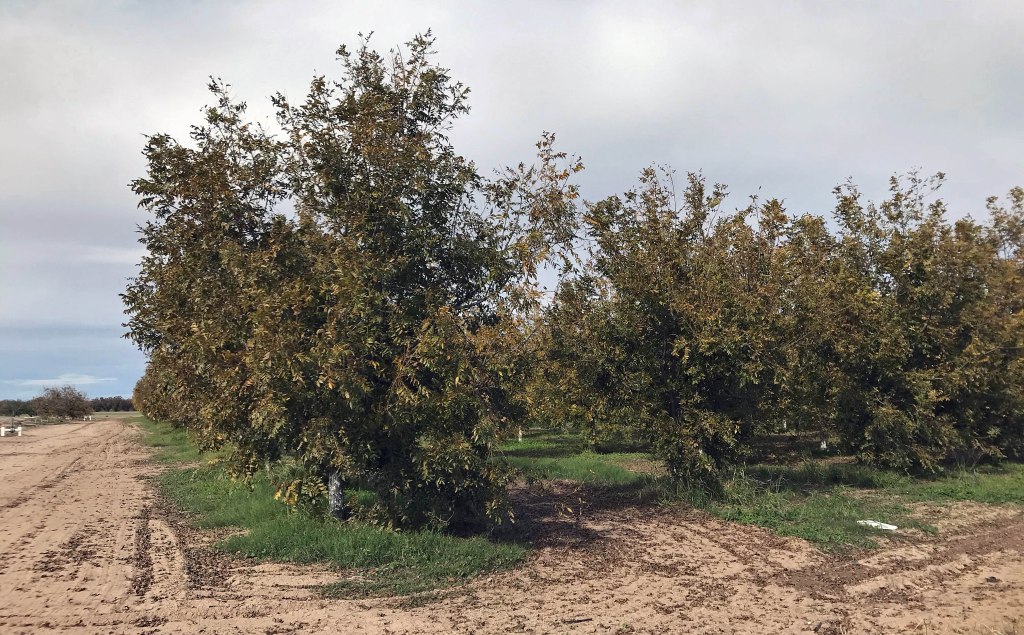
The road angled northwest, then north, and took us through a flat stretch of land that made us almost homesick. Dirt driveways led off the pavement toward ranch-style houses, each with a clutch of extended-cab pickups sitting in front. In between lay what looked like pecan groves alternating with sheep pastures, all connected by a network of canals.

Eventually, we met the main artery out of Hermosillo, which led us straight west through more ag land, with osprey nests at regular intervals at the tops of the telephone poles.
The town of Bahía Kino – one of hundreds of Sonoran locations named after the 17th Century explorer-priest – sits at the base of a long spit of land that shelters a large estuary from the rougher waters of the gulf. We followed one of the streets that angled toward the shore and then looped back around, past the mostly shuttered seafood restaurants and cabanas.
To the typical gringo, Kino Bay actually means a place several miles up the coast – Kino Nuevo, a strip of quaint condos packed tightly along a uniform strip of sand. Among her wealth of memories, Lori described how she and her group of college buddies would migrate here every year and camp on the now-developed vacant lots between beach houses.
The beach dead-ends at a barren hill of crumbling red rock, beyond which, in high season, is a popular launching point for boats. We parked and hiked up to a vantage point overlooking this deserted pocket.

Perceiving that Lori was processing memories from the other end of bygone decades, I continued up the hill, where I had a breathtaking view of the mountainous Isla Tiburon, homeland of one of the last North American tribes to give up their traditional ways. Known for their hostility toward the pale-skinned invaders and for the ubiquitous carvings that have all but meant the end of their mighty stands of ironwood, the Seri Indians now live mostly in material and cultural poverty along the coast of the mainland facing the island.
In Lori’s college days, a primitive track led from here to even more remote party spots, but now the gate to an upscale development blocks the paved road. Under a slate-gray sky we retraced our route along the backs of the beach houses, pausing to refresh ourselves for the long ride up the coast at a modern coffee and juice bare on the outskirts of the old resort town.
An episode of Twilight Zone
Our sturdy new map of Sonora did not show that Hwy 3 goes all the way through along the coast, but we chose to believe our cell-phone app, which claimed it did. Either way, we assumed that, if there were going to be outlaws anywhere, it would be here.
We were even more nervous once we turned north onto the pot-holed corridor walled in by high thickets, so we pulled over at the village of San Antonio – really nothing but a run-down general store – where a sheriff’s deputy was parked in his SUV, and asked for another assessment. Unlike the federale from earlier in the day, this guy was open and friendly, assuring us that the passage was muy tranquilo. I think we even had to talk him out of giving us an escort.
It was a long stretch, a blur of unbroken desert, with the higher points of the big island shifting in and out of view, until we again met the coast at Puerto Libertad. East of town along the highway lay a couple of vast solar arrays, with cleared land around them that suggested plans for expansion.
Except for the throughfares themselves, this was one of the few alterations to the landscape we had seen during these wanderings around the desert south of the border, but I had a moment of dread that this would become a familiar sight as the planet careens past a point of peak oil and toward a desperate quest for alternative power.

At one point on our way north we crossed an especially lush panorama – a symbiosis of saguaro, organ pipe, cholla, mesquite. The slanting sun lit this lush carpet into the far distance toward the sierra, and over the whole scene hung the most vivid rainbow I had ever seen, unbroken from end to end. One of the longest lasting, too, and we ate up a fair piece of our remaining daylight taking it in.
The heart of The Problem
Though smaller and more intermittent than the plains below Hermosillo, the ancient delta-land of what is now called the Rio Concepción also is a stretch of significant agriculture. Our eyes as always bigger than our stomachs, we briefly considered a detour inland to Caborca. This indulgence reminded me of a similar moment, perhaps equally foolish, on our way across Sicily when we had no time to spare but were drawn to the name Corleone on the map of the nearby hills.
Some recent reading tells me that Caborca is the long-time hub of the drug trade in all of northwestern Mexico. If this is not the Sonora’s most important industry, at least it is the most enduring. Directly or indirectly, it is the main source of much of wealth even in the remotest villages, and anyone who offers any hint of resistance to the shadowy organizations disappears with little official notice. Now and then a newspaper publisher or newly appointed police chief declares that enough is enough but is quickly executed in a public barrage of gunfire. In that light, one can scarcely blame the rank-and-file Federales for expecting some token piece of the action.

Even with miles of new border wall and growing competition from the legal cannabis industry, the U.S. demand for imported euphoria remains the single biggest fact of life to Mexicans on the other side. The pioneering science fiction writer H.G. Wells once said that when a civilization begins to decline it turns to eroticism and art. He forgot to mention mood-altering substances.
For decades Puerto Peñasco, so popular to week-ending Arizona urbanites, has appeared immune to el problema, but more recently the violence has found its way even there. It occurred to us, as we crossed that transition zone from the Central Gulf Coast into our own Lower Colorado River subregion of the Desert – an endless expanse of creosote bushes, here tall and close, further on skimpy and sparse – then sped along the coastal sands into a vivid sunset behind the gulf resort city, that the tranquil passage of Sonoran Hwy 3, having been improved all the way from Kino Bay to San Luis, must finally have come of age as a connector between the nerve center of the drug trade in Sinaloa and the border cities of Baja California, those gateways to the urban centers of Southern California. And by the following afternoon we had traversed the length of that route in a little over a day.
Familiar ground
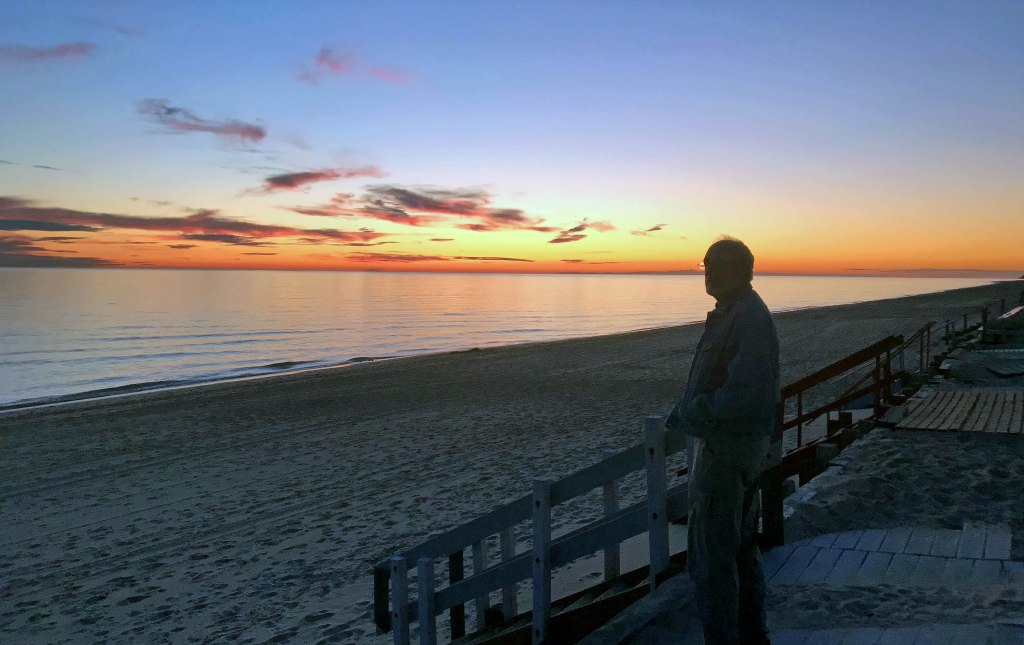
The strip of beach where Grandpa Bob has his condo – the old unbroken line of one-story duplexes stretching to the east – now has a guard station. We unloaded for the night just in time to catch the dying glow of sunset beyond the namesake rocky point from the front patio, the lapping of the low tide far out in the dimness across the sand.
Four of the six revelers being past 80, the other two having logged a 12-hour drive, we had the earliest New Year’s Eve on record. We made the most of it though. It was the most fun I remember having with Lori’s aunt, a certified triple-threat performing artist. I had never quite realized the extent of the verbal rivalry she had with her brother, but it was well worth the price of admission. I didn’t know her well enough nor did I have the context to join Bob’s jibes at her expense, so instead I cheerfully chimed in on her behalf. Poor Bob.
We got an early start in the morning because our college kid had been home for a week, alone except for the hyper German shorthair. Besides, we wanted to get to San Luis in time to cash in the $500 deposit we’d put down on the Honda on our way to Álamos. Though San Luis is only 20 miles from home, a separate trip across the border is always best avoided, wait times having always been around 75 minutes, now extended under Trump to as much as four hours.

I am always mesmerized by the sight of the Pinacate shield volcano – easily my spirit place on the planet – as we wheel by on that stretch of Hwy 3, which of course wasn’t there back when we had made our regular pilgrimages a quarter century ago. When we came to the Adair Estuary, we spent a few minutes poking around the empty shell of the research station, enjoying the bird life among the bushes.
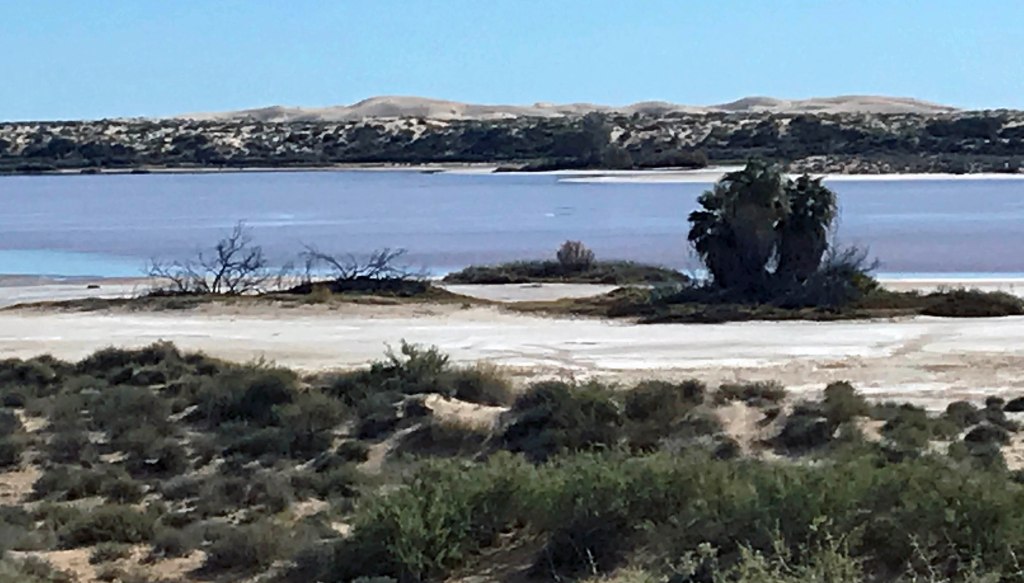
We realized we weren’t going to make it back to the border before we needed gas, so we took the detour into El Golfo, fingers crossed that the Pemex would be open on New Year’s Day. I hadn’t been into town in 30 years and was stunned at how it had grown. Of course, we had to take our picture at the beach overlook, with its six-foot bold-color letters spelling the name of the town.
The longest meter
Whatever the ample charms of Mexico, getting accurate information, especially on topics of public relevance, is not one of them. We had read definitively that we would be able to get our car-deposit refund, even on the first of the year. But the bank was not at the address listed, and, when we finally found it, of course it wasn’t open.
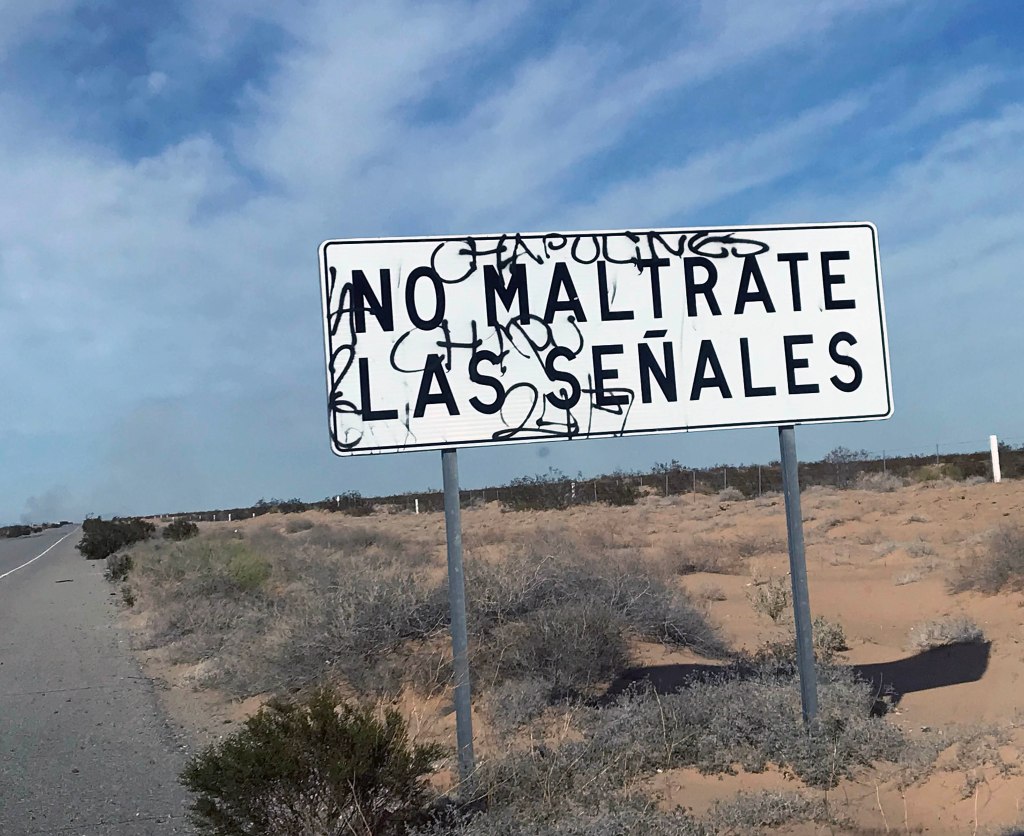
Along the interminable stretch of the ironically named Avenida Independencia, with its unbroken barrier of upright landing strip sections, Vietnam War surplus, I think we listened to two entire Broadway musicals.
We were supposed to be in the line with reduced scrutiny granted to the privileged class with the new passport card. We got a hard lesson, though, in line jumping – the fine art of covering most of the distance in the special-permit Sentri lane, waiting for someone to leave an opening of more than three feet, and then cutting in, daring the enraged driver to hit you. Literally, you didn’t dare take your car out of drive.
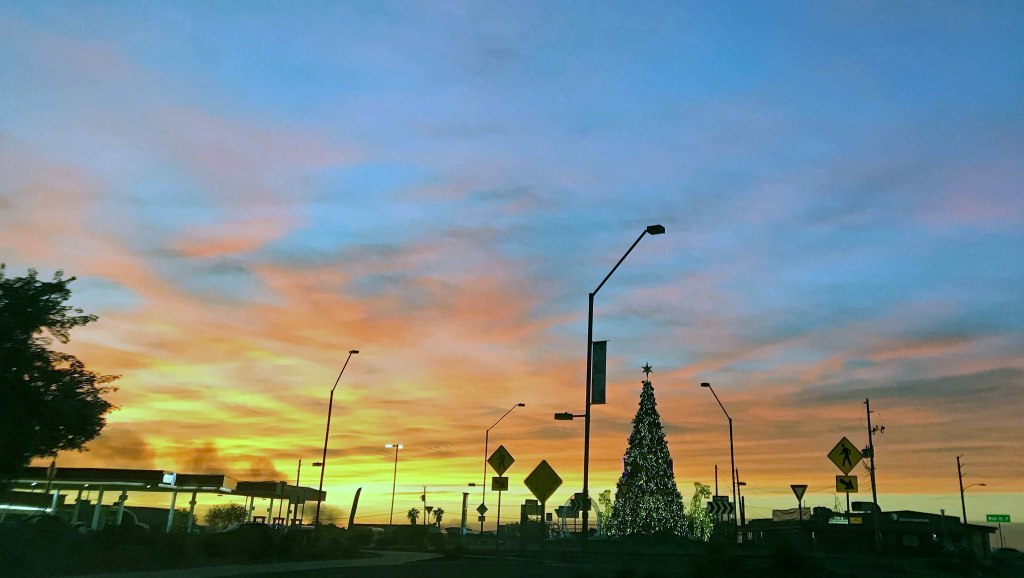
I actually might have jumped out to buy a carton of eggs at one of the markets facing the street, but that would only have created more opportunities for the anarchists. Anyway, against our increasingly belligerent immigration policy, there needs to be at least some recourse to a symbolic gesture.
Speaking of that, a month or so later Lori made an abortive attempt to get back across on a weekday to cash in that deposit. (A few weeks later, the pandemic made the idea impossible not to mention inadvisable.)
It’s almost worth the lost money to be able to tell the story: On that very afternoon, the border was closed because our illustrious governor, our favorite xenophobic U.S. senator, and the acting head of Homeland Security (acting, because then he didn’t have to be approved by Congress) had scheduled a photo-op nearby, a reaffirmation of their antagonism to any and all races, creeds, colors and personalities appertaining unto the more southerly latitudes – this being the mother of all election years.

 Sonoran Visions