We woke in our cabana, invisible birds chorusing all around us among the jungle of greenery that played and shifted against a cloudless sky. We pondered at length (woe to the wicked!) how we could possibly face the day, no obligation to man nor god other than to explore from bell tower to backstreet to streambed this pocket of paradise nestled against the foothills of the Sierra Madre.
Finally, we dragged ourselves into the crisp air from beneath the king-sized down comforter, dressed at leisure, and followed the freshly raked gravel path over to the dining room, where we were again the only guests in sight. We filled up on eggs to order – rancheros for her, a la Mexicana for me, as customary – on the strong coffee, and on whatever applicable wisdom we could harvest from the shelves of our hosts’ personal library.
The three realms
In an intentional progression from the cultural to the natural, we began with a trolley tour that carried us through the quiet neighborhood we had toured the day before, beside the channelized bed of the main drainage, then to the eastern outskirts where the road headed into the inscrutable hinterland.
Our driver-guide was a high school history teacher on midyear break who, seeking to display the full range of his erudition and bilingual skills, made a show of probing the various layers of creation, with occasional English translations for what he assumed was my benefit.
The ornate colonial casas, he explained, represent the temporal realm of history and geography. On the grounds of one particular villa, though, the ghost of a teenage suicide is doomed to wander between worlds, her passionate love having been forbidden by tyrannical parents. And the cemetery, behind its long stucco wall and row of ancient fichus trees, holds fast the centuries’ accumulation of local souls – though strange glows are indeed known to dance among the tombs after dark.
A deep history
Next on our itinerary was the municipal museum, which, occupying half a block along the main plaza, is impressive for a town of that size. Some rooms are dedicated to the work of local artists, much of it for sale, and we had to exert special effort to restrain each other, lest we should end up driving back with a carload of can’t-do-withouts that would only become can’t-possibly-find-a-place-fors back home.

The praiseworthy contributions and elegant wardrobes of the dynastic families are of course well represented in sepia photos and yellowing newsprint. Items of an ordered daily life – carved wooden furniture, hand-painted china, and fashion accessories of intricate lace, which no doubt would crumble under the slightest touch – had cumulatively buffered the colonials from the savagery of their surroundings in this outpost a thousand rugged miles from the center of culture beyond the mountain passes.
The most interesting displays, however, are of mining tools and machinery that attest to the soul-shattering labor of myriad voiceless peones and their resourceful masters, who powered the history of the New World with their stream of shining metal.
A separate reality
Reemerging into the glory of the cloudless day, we spent the next few hours wandering the narrow cobblestone streets. For starters, we returned with the impulse of addicts to the high-ceilinged restaurant behind the cathedral where we had the day before sampled a heavenly albondigas recipe with garden-fresh vegetables on the side.
On one nearby street, artisan tables seemed to have spilled from among the arches of the elevated walkway in front of the historic Hotel Colonial. Indulging her craving for the human connection and for Día de los Muertos imagery, Lori chatted up one of the vendors at some length before coming away with a small painting of a skeletal couple with toothsome grins. As we moved on, she pointed out a house on the corner that the artist had told her was owned by a couple from Yuma. We would have knocked on the door, but they wouldn’t be there till summer.
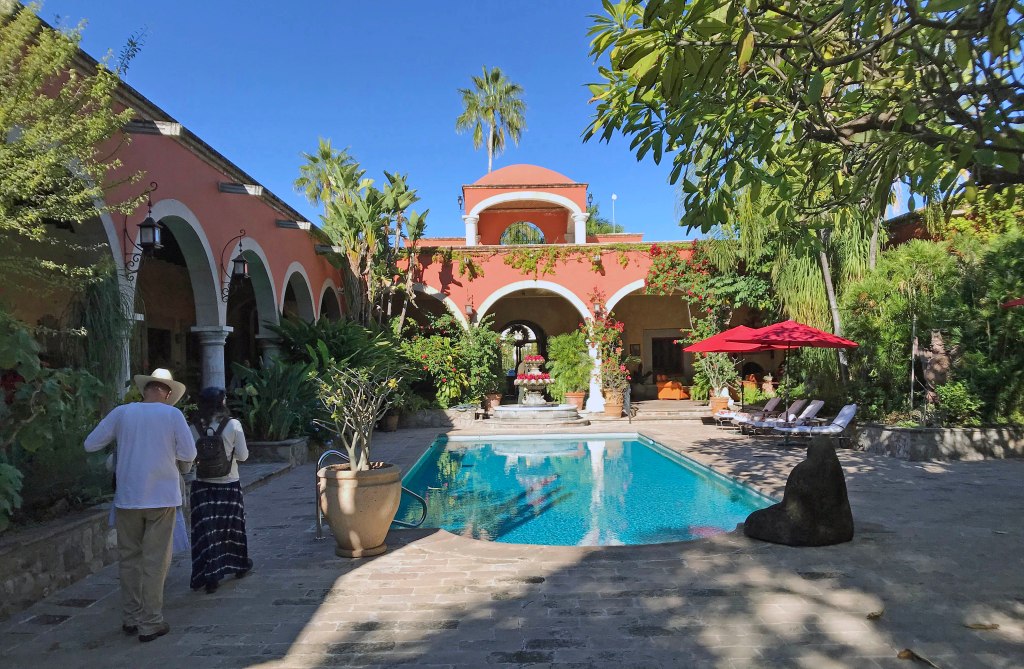
We had been encouraged to gate-crash the grounds of the top-rated resort, the Hacienda de los Santos, a couple of blocks away. As we were slipping through the entranceway, Lori thought she recognized another Yuma citizen, a tycoon in the multibillion-dollar ag industry. Sure enough, upon inquiry it was the venerable old gent himself, enjoying some leisure time in the foothills with extended family while plying his petrochemical trade here in Arizona’s sister state of Sonora. Assuredly, this unexpected link between the expanses of man-made greenery out on the nearby plains and the aesthetic of our own familiar alluvial valley a twelve-hour drive away relieved us of any hint of homesickness.
The Los Santos estate is indeed the choice location within the boundaries of Álamos, with its wide lawns, its subtropical landscaping, its hidden niches, its corridors lined with art and photo exhibits. It has at least two restaurants inside and two outside, and even a wedding chapel. What appears to be a concert venue is under construction behind a temporary fence. Quaint bridges span the rocky arroyo that winds down out of the hills on its way to the main drainage bisecting the town. A separate reality for the initiated.
Another walk in the park
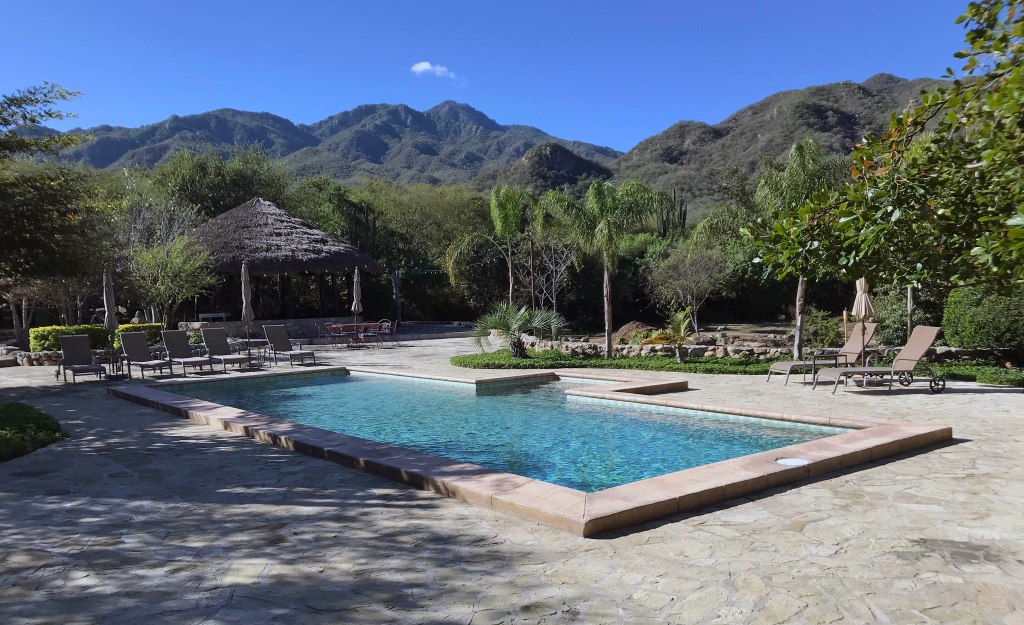
The surrounding forest being the main rationale for our trip, we made another foray from our “Nature Hotel” up into the Parque Colorada, this time sticking to the lower trails that loop wide toward the north, abutting the private land in the valley where the city sits.
The sun already had slipped behind the hill, but we saw at least one couple heading up the path toward the outcroppings that we had explored the day before. We wondered too late if we should have said something. Even if they had enough battery to get back by the light of their cell phones, the paths were labyrinthine, the woods were too dense to see out of, and there would be no moon.
We found ourselves playing leap-frog on the trail with a pair of well-mannered youths who would hurry by us as if on an urgent mission, only to be found dawdling beside the path, inspecting some rock or plant or bug with a toddler’s fascination – a behavior easily explained by the skunky scent of cannabis that hung among the branches.
At one point, we came across a family with three girls in their latter teens, milling tentatively in a hollow where several main routes intersected. They, too, might have wandered lost all night if they hadn’t been convinced to follow us based on our rudimentary trail map. At another juncture, the stoners reappeared, as if drawn by some invisible force to the location of the three young women. We knew our way back from here, but we were happy to let them save our lives by guiding us the rest of the way in the gathering dusk.
Last looks
It being Sunday evening, the crowds on the city square had thinned out, most of the day-trippers from out on the plains having returned to their urban lives. The outdoor taco operation that had been mobbed with business the night before was tarped over, its adjacent picnic tables tipped together in a pyramid. There was still a long line in from of the churros stand, though, and we found out why when we bit into those fresh, hot sticks of deep-fried dough.

In the morning, we spent some time communing with our hostess and her sweetly disposed dogs. It turned out she was something of a birding expert who, in more carefree days, led specialized ecotours up and down the coast. Yes, she said, this should be the high season, and the cabañas would be booked up but for the tone of the travel advisories. We would learn later that El Pedregal had to close for nearly a year due to the pandemic.
We made one last pass down the cobblestone avenue that curved down to the city center, past the most upscale of the renovated casas, with their wrought-iron window gratings, their quaint niches, their layered roofs. This time we angled back into the succession of narrow streets that finally empty out onto the ramp-like ascent up to the Mirador.
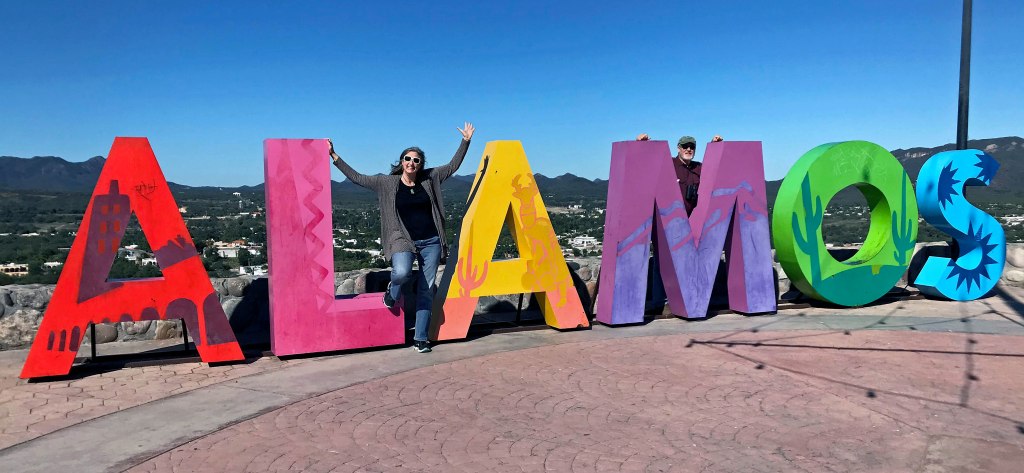
Granted, it was still early on a Monday morning, but none of the souvenir stalls on the flagstone promenade was set up for business. We had the run of the overlook on that cloudless morning, taking our fill of silly selfies among the huge metal letters spelling the name of the town – evidently a standard feature of Mexican communities, at least across Sonora.
Passing the binoculars back and forth, we entirely lost track of time studying the vista that we had been exploring for the past couple of days – the cathedral and adjacent zocalo, the whitewashed maze of colonial houses, the neighborhoods clinging to the slopes of the higher ground behind, the rocky arroyos snaking through it all. And of course there were the verdant hills in every direction, those to the west, south, and east designated as Area Protegida Sierra de Alamos, with its Cuchujaqui River trough sweeping out of sight into the perilous lowland of Sinaloa.
The Great Hereafter
On the way out, at the foot of the hill, we saw a road leading away into the unknown countryside, and of course the steering wheel naturally turned itself that way. After the first few yards, though, the pavement suddenly became unimproved dirt, zagged sharply, and began following the backside of the hill. This was the hidden face of the affluent community, with heaps of household trash, broken furniture, rusting appliances, mounds of construction waste, abandoned vehicles. We passed one dwelling that might have been up to code, but mostly there were makeshift shacks on patches of littered dirt, with perhaps a twisted antenna propped at one corner and laundry strung on a line between two trees.
The dry washes that drained the hill had cut deep grooves in the road – or rather the dirt track connected these washes – and if it had been anywhere close to the rainy season, the Honda would have sunk to its windows in mud. This would have been a very inopportune place to get stuck. Finally, we did cross a running stream, and then we recognized the main arroyo and the throughfare running out of town to the east.
Since we were on this side of town, we thought we would pay a more leisurely visit to the big walled cemetery we’d seen on our tour the previous morning. As we stepped through the pedestrian opening within the main gate, it occurred to us that the citizens of Álamos must be feeling confident in a long life, because surely there was no more room for them here.

Every monument, crypt, or sarcophagal stack sits flush against the next in packed rows stretching into obscurity in all directions – all of it seemingly oriented toward the west. Weathered stones dating from the 17th Century abut sparkling marbles from the 21st. The massive roots of fichus trees have long since tilted, split, or upended some slabs and even swallowed some graves whole within their folds. Entire clans – Palomares, Contreras, Lalido, Espinoza – have staked out borderless barrios with their matching Jesuses, bouquets, lettering styles, pastel hues. The afterlife has never seemed so lively.
All too soon
On our final pass through town, we drove down the street where we had made our tour of restored houses. Our friend the Dead Head dentist had his front entrance open to the breeze, and there he was sitting on a stone bench in the inner courtyard restoring some broken fixture. We honked, exchanged waves, drove on.
Our last task was to visit the municipal artisans’ market at the edge of town. Only two women were tending the many sectioned stalls in the long hall, and we were the only customers. They drove a hard bargain, holding their own against our competent Spanish and our mathematical gymnastics. Not that we had a whole lot of room in the hatch for exported treasures, but we did manage to find a couple of regional masks for our collection, and we became the humble custodians of a well-worn grinding stone.
It was with full satisfaction and a tinge of sadness that we negotiated the narrow neck of that lush valley and descended into the open plain on the way to Navajoa.

 Sonoran Visions