The northern plain of the Pinacate preserve is stunning – with its two spectacular but very different maar craters, its young lava flows, its exotic vegetation. But that is only the most accessible corner of the Biosphere.
The shield volcano itself, which looms in the background, stretches for miles southeast to northwest, tapering down to Mexican Hwy 8 on one end and trailing off into a cluster of dramatic maar craters on the other. Its flanks are pocked with cinder cones and striped with overlapping flows of various ages and shades, some seemingly smooth and downy, some marred by giant chasms where the lava buckled or shrank.
To the native peoples of this area – long since dispersed or killed by the waves of armored gold seekers and, later, vigilante cattlemen – this was the navel of the known universe, the hub of creation. The creator I’itoi himself, sacrificed and buried by his own people in accordance with the universal archetype, reemerged from his subterranean lair high on the mountainside to enjoy an unbroken view of his realm.
For a period of several years, I took every opportunity to join him.
World’s best campsite
Base camp for the north slope of the mountain – the approach almost all visitors make – is a quaint bowl of cinders and sagebrush in the shadow of a dark outcropping, one side of a collapsed vent known as Red Cone. Many were the times we hastily packed the Jeep on a Friday afternoon, arrived at the Suvuk Mountain intersection well after sundown, and crept along the rocky road that tacks back and forth over crumbled flows on its way up the slope.

Finally, we would pull into the shelter of our favorite campsite – a classic symbiosis consisting of a broad paloverde, a soaring saguaro, and a multi-fingered senita – nestled against a wall of black boulders where a flow from the top had run out of momentum. As soon as we opened the car door, the dog would race around the area in search of jackrabbits, shredding her tender paw pads on the cinders, mindless of the fact that she would now have to convalesce in camp all weekend while the rest of us hiked.
If we did arrive with any remaining daylight, maybe one of us would set up camp and unload the firewood (no gathering in the park) while the others ascended the birthday-cake silhouette of the hill for a view of the winter sunset.
Dancing spirits
The obligatory short hike from Red Cone leads across a series of broken flows to Amelia Tanks, a cluster of high-walled catchments that hold at least some water even in the driest of seasons. It is only because of places like this – scattered throughout the hills, some probably not yet discovered – that the larger species, human and otherwise, could have survived here.
Above the rim of the tanks, on the opposite side of the rising sun, is an array of rock piles, all of the same size and the same cocoon shape. A moment of observation reveals that they are hunting blinds, open on the backside, half dug and half built up – in any case far too small for modern humans.
No doubt this whole area was still littered with arrowheads and pottery shards not long ago. The aprons of the water holes are still pocked with mortar holes.
Sitting for hours, as the visitor must, in the air-conditioned stillness of the twisting gorge, with reflected light from the pools dancing on the rock walls, she will begin to see the reincarnate shapes of women and children, naked and laughing – an active, thriving community.
Summit junkies
Only Carnegie Peak, the lesser of the two summit cones by a few feet, is visible from the environs of Red Cone. The best approach to the top is straight at it, up the gentle slope of packed cinders, though the hiker needs to step carefully around the litter of fuzzy tufts that have fallen from the pervasive cholla trees. Certainly no place for a pet.
Evidently, there’s a whole subculture of summit-junkies out there; and, when you’re going to drive hundreds of miles, knock out a peak, and drive home all in one day, you need to be in command of all the details. Once when I was camped at Red Cone, a couple of vans pulled up and disgorged a dozen members of a Phoenix-area hiking club, who launched up the slope without ceremony, obsession in their eyes.
In a couple of hours they were back, having climbed both cones, and their vans were clattering away in a trail of dust. A hobby far preferable to off-roading, no doubt, though I couldn’t help thinking it was somehow akin to trophy hunting. I prefer to think it’s about the process, not the product.
First foray
Of course, you could argue that I let the process of climbing that mountain drag on a bit. On my first foray, I was with my son, probably 8 at the time. I was still a desert dude and for some reason thought the preferred route was up a wash to one side. I ended up dragging him through a bed of soft cinders that got deeper as the slope got steeper.
Finally reaching the base of the cone, we searched for the lava tube we had heard about, dubbed I’itoi’s cave. It wasn’t hard to find; part of the roof had collapsed perhaps half a century earlier, so the entrance was a big open pit mostly filled with boulders.
The cave itself is a string of chambers big enough to walk in upright. No one had been inside for a long time, maybe years, because there were no footprints in the fine silt covering the floor. Leading in from the outside were occasional side tubes, but they were too steep to climb.
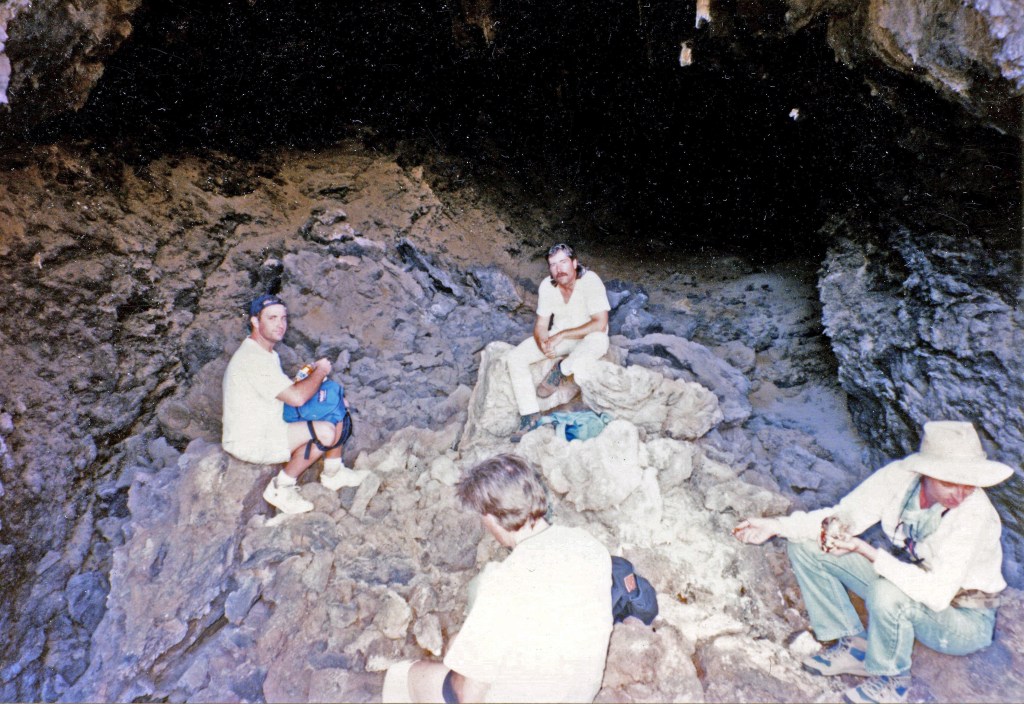
When I returned there a few years later, I didn’t dare go down because a colony of very noisy bees had set up shop on the rim, angrily investigating anything that came near. Allergic or not, you wouldn’t want to get swarmed many hours away from medical help. I chalked it up to another case of nature making its last desperate stand.
The low road
Back outside the cave, we stumbled upon a row of features that looked like huge petrified wasp nests. It wasn’t hard to figure out that they were vents, about the height of a person, where trapped gas had bubbled up from the molten rock. I dropped a pebble into one but didn’t hear it land.

We continued around the base of the big cinder cone, and shortly discovered a jeep track, no doubt the extension of the road up to Red Cone. In years past, the road had climbed the steep upper lip of the basin, but it was now blocked off by huge boulders that could only have been deposited by heavy machinery.
For the sake of variety and curiosity, we started to follow the road down. We soon realized, though, that it was wandering too far afield to get us back to camp before dark, so we struck off over the uncharted lavas.
Alone together
Since we were cutting laterally across the slope, we traversed elevated flows of various ages – the fresher ones sharper and more treacherous – separated by valleys of sediment and cinders. It was a truly surreal landscape, with bright yellow fields of blooming brittlebush, and red-crowned barrel cacti lodged in the crevices at impossible angles. But it was about as rugged as could possibly be, and it went on and on.
At one point, before starting up the edge of a new flow, I looked back to see my son, doing his best but just coming off of the last one at the far side of the ravine, and I figured I’d better slow down and let him catch up. I remembered this moment when, on a later trip down on the plain, I saw a bobcat following him. Way up here on the mountain, it could easily have been a puma.
Finally, we came to the road again and, when we could see the campfire, I told the boy to hide.
“Where’s James?” asked my friend, who’d had to sit out the hike due to a flare-up of his fallen arches.
“What, he isn’t here?”
No way to treat a friend, I’m sure, but he had insisted that the kid would never make it.
The high road
Over the years, we gradually worked our way toward the summit. When we finally made it to the top of Carnegie, we found ourselves looking over the edge into a half-eroded crater. Across a wide saddle to the south sat the smooth big-sister cone, Pinacate Peak. Behind it lay the blue expanse of the Sea of Cortez and, in the distant haze, the high points of the Baja Peninsula.
Finally one Easter, on what we knew would be the last mild weekend of the season, we determined to get to the top. Since we had a dog and a preteen, we knew we’d never make it all the way to the high peak from Red Cone, so we powered the Jeep up the slope out of the basin and bumped along the upper stretch of road. We camped down off the road in a gully, still a mile or so from the base of the twin cones, intending to hike from there.
In the morning though, before we could get moving, we heard a motor laboring in the distance, and shortly a Suburban crossed above us on the road and headed up the hill. We reasoned that at least we wouldn’t be the only ones breaking the rules, so we loaded up and followed.
To the top
The Suburban had parked at the end of the road, on a flat depression below the two peaks. Our fellow travelers, it turned out, were an Hermosillo lawyer or engineer, I can’t remember which, and his four children – a girl of about 15 and three young men up to about 23. He had come here as a teenager himself and had been deeply inspired.
We started up the soft, snaking trail – one eager expedition. To our surprise, our son and dog were the first to the top, ahead of all those hearty adults. His stamina had evidently improved in the past couple of years, and we had learned to outfit the dog with special booties.
The view was everything we had been anticipating – massive lavas spilling down the southern slopes, a few cones and even a crater down on the desert floor. A thin line of railroad track cut across the field of pristine dunes that fanned out to the shore of the Gulf. The town of Rocky Point huddled around its curving bay a short way down the coast.
It was actually kind of cold there at 4,000 feet, and breezy, so we couldn’t linger long. We all took each other’s pictures and traded promises to keep in touch.
We didn’t, of course, but we can all still see each other clearly, there at the center of Creation.

 Sonoran Visions