Having been introduced to the Pinacates during my second Southwest winter, I had to get back down there the next chance I got. By Easter, I figured it would be too hot if I waited any longer, so I decided to try a solo run.
I freely confess to a congenital streak of rashness, especially as concerns travel. At that time, my only my vehicle was an antique Mercury Comet (an apt moniker for that canary-yellow-and-white design) with over 200,000 miles – a rolling miracle for that era of Detroit technology. In any case, you couldn’t even attempt the type of off-roading I was about to do in one of today’s low-slung highway cars. I know, I’ve tried.
I actually did entice someone to go with me. As a native Arizonan, she probably should have known better than wandering into the wilderness that way – in Mexico, no less – but courtship is crazy that way.
With fresh eyes
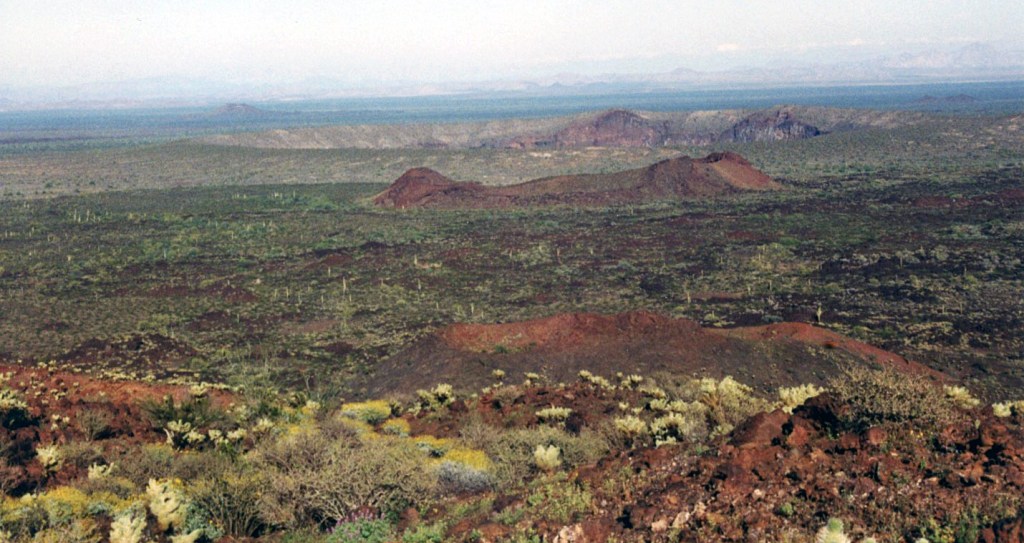
In fact, piloting the Comet across the sharp rocks and sandy washes inside the park turned out to be even more demanding than expected, and it was an early tutorial for me on off-road technique. At first the open desert was open and flat, with creosote bushes and prickly pear clusters spaced widely the field of black stones that had been launched from who knows how many miles away.

As we inched south toward the vast shield volcano, the texture of the terrain gradually morphed into rolling mounds of volcanic cinders, studded with unearthly cholla trees and the occasional organ pipe or senita cactus. Since it was early in the day, I skirted the high rampart of frozen lava where I had camped a couple of months earlier and headed deeper into the preserve.
From anywhere on the desert floor, the big maar craters look like nothing more than low, featureless ridges, so it’s easy to see why the explorers who began crisscrossing through region shortly after the Conquest never found them for 300 years. To honor that tradition, I saved the stunning discovery of the big Elegante crater for my companion. Cresting the rim of that silent, yawning cauldron – without the false comfort of a guardrail, warning placard, or watchful ranger – I think she had a bona fide case of vertigo.
An aerial dance
A mile or so to the east of the crater, a tight cluster of jagged hills jutting up from the desert floor – probably hardened segments of a flow that had been upended by fresh lava pushing in from behind. The friend who had introduced me to the place had dubbed this feature I’itoi’s Castle, after the Papago deity who still had a claim to various properties in the region – I’itoi’s Cave, I’itoi’s Throne, and so on.
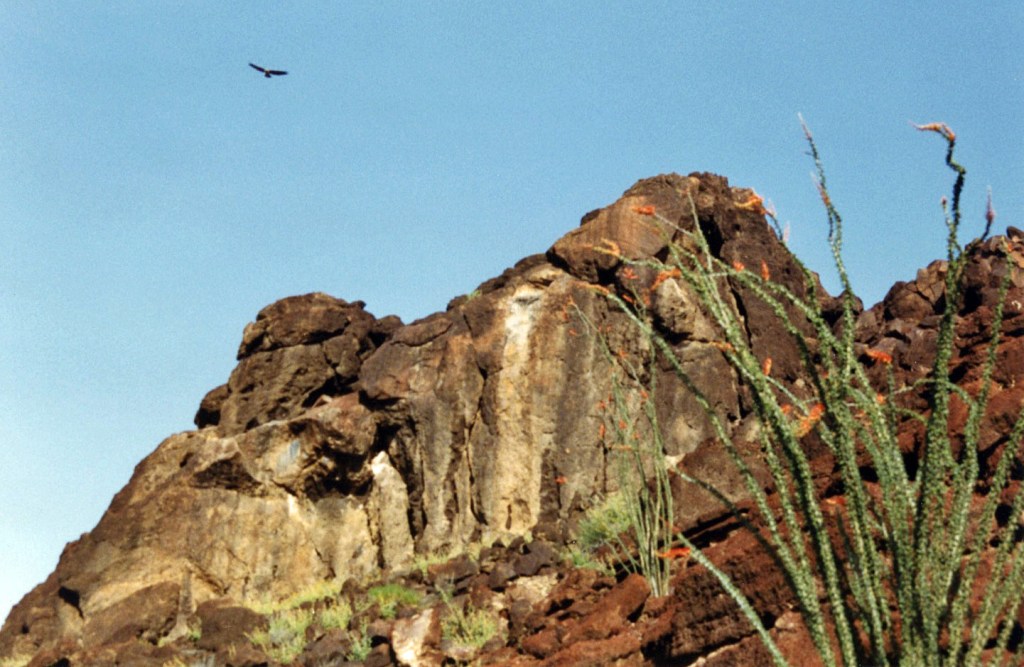
My companion and I set off to explore this charming feature, at first following the crater’s rim, until it started veering north in its long sweeping arc. As we approached the hills, we could see a pair of large raptors coasting in the air currents above the crags, hoping for some luckless cottontail to venture into the open from one of the mesquite umbrellas dotting the nearby drainages.
For awhile, we scampered around on the outcropping as if it were our own personal playground. Finally, we rested in the shade of an overhang while the birds circled overhead, coveting our snack of tinned sardines.
At the time, we speculated that these were osprey, though they had set up shop on the opposite side of the mountain from the Gulf, and I don’t know if osprey have that great a range. In those days we weren’t nearly as serious about keeping a photographic record as we are now, so we don’t have a good enough image to show around. Whatever they were, they treated us to one of the most graceful couples dances I have ever seen in desert, though I was too much of a novice at the time to fully appreciate it.
Celestial light show
By the time we got back to the car, the sun was low, so we scouted the nearby washes for a campsite. We probably were the only humans in a ten-mile radius, but we figured we ought to stay safely incognito.
Although I’m descended from a clan of avid campers, I must not have been required to help much with food preparation. After that night, though, I can offer one unambiguous lesson: Don’t try to cook meat over open flame, especially if it’s windy.
Yes, it would be years before we honed the technique of selecting mesquite branches and letting them burn down to glowing briquettes, particularly for chicken. At the time, I’m sure we were enjoying the experiment and each other’s company, and we had worked up enough appetite to eat anything, but in later years we probably wouldn’t feed those blackened, ash-coated thighs to the dog.
Since it was a first date, I assigned my companion to the master bedroom, a department-store dome tent, while I stretched out next to the waning fire. A chill wind had begun funneling up the wash, somehow pushing into my face no matter where I positioned myself.
I didn’t get much sleep that night, but the bright side was the sustained spectacle of sparkling Milky Way, sudden meteorites, and even a faint, dashing satellite. The one-day-old moon had only a few minutes in the sky before it plunged into the orange glow that slowly died beyond the horizon.

For some reason, in all the places I had lived I had never seen the full outline of the moon in its crescent phase – the reflected light from Earth. To this day, nearly 30 years later, we refer to that sight – the delicate sliver clinging to its spectral disc – as our Pinacate Moon.
X marks
Our goal for the day was to explore an area we had studied from the rim of the crater, where a faint jeep track wound across the washes then headed straight west across the flats, finally disappearing into a field of cinder cones nestled within the curve of the volcano’s long, tapering tail. A dense mesh of high clouds would make for a cool day and good stamina.
We packed the Comet and began traversing the drainages radiating down from the crater. We soon came to one, however, that appeared too daunting for two-wheel drive, so I concealed the car under the canopy of a paloverde, and we proceeded on foot. It turned out that, if I had been just a bit more daring, we would have emerged onto the flats and had clear sailing for several miles. But we were content that there would be no boring views in any case.
Indeed, no two pockets of this alien landscape were the same. We crossed one lava flow after another, each with its own shade somewhere between brick red and coffee black. We zigzagged among the ridges and arroyos, occasionally trudging knee-deep in abrasive cinders to the top of a cone to see if it still had an intact funnel, like a giant anthill.
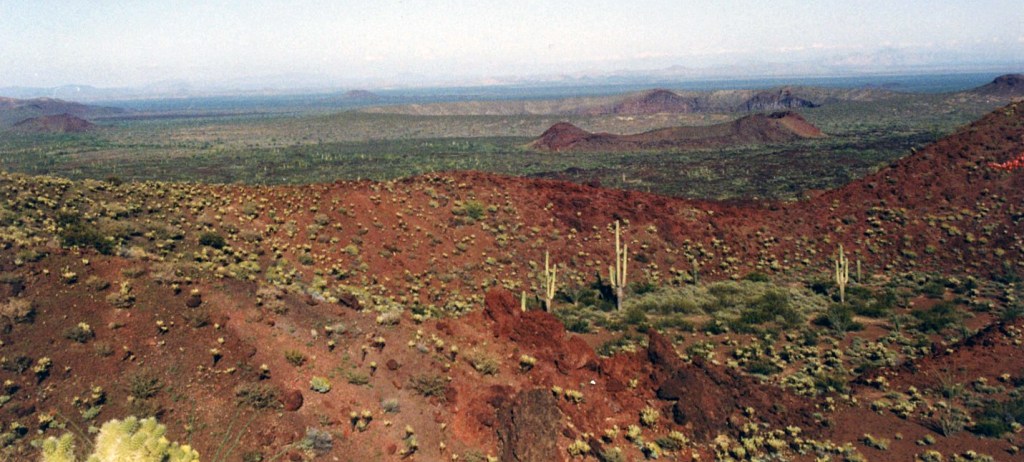
Finally, we summited a rise overlooking a narrow valley filled with pitch-black lava, by far the freshest we had seen. In its center was huge hideous scar, a smooth X that could only have been made with a bulldozer. We immediately recognized the drop zone for a drug-runner’s small plane.
The biggest thrills are free
At the edge of this hidden valley, we found a small cave, a space where the lava seemingly had frozen so quickly that it didn’t even have time to collapse. From there we contemplated this fresh flow that had oozed to a halt here only a few thousand years ago – a blink of a geological eye – feeling we had barely missed an actual moment of creation.

We could have kept heading west along the mountain for days, and along the way we would have stumbled across spots that no human has ever seen. In the process, we also would have encountered non-human creatures that had never laid eyes on the likes of us.
We had to wonder what treasures were out there on that lunar surface – unclassified species of cacti, bits of rare mineral lying exposed on the desert varnish, water catchments that only the animals knew. With the optimism that overflows in the prime of life, we even thought we would come back to find out, but we never have.
As it was, we had spent our allotted energy for one day. On the way back, we didn’t have it in us to climb many more ridges for a quick look around.

At one point, though, we skirted a row of three cones, triplets that were no doubt born from the same vent, and I just had to climb the smallest one. I found that I couldn’t walk down the packed cinders on forward side, though, because in those days my only outdoor footwear was a pair of old work boots, their soles finally worn smooth after a couple of days on the rugged rock.
Having no intention of adding any steps to my day by backtracking, I took a breath, slid halfway down the slope, then bounded the rest of the way, sailing many yards through the air and plunging up to the knee with each leap. It was a thrill I would seek out many more times, until I bought new boots. Later, I found out that cinder skiing is an actual thing.
Ghosts of Highway 2
It was full dark well before we emerged from the preserve, so I had to navigate the rugged road in the headlights, the shadows of cholla trees shifting eerily in front of me.
As we reached the pavement of Hwy 2, I realized that we didn’t have enough gas to cross the deserted 100 miles back to San Luis. But I also didn’t want to add another 40 miles by driving the other way to Sonoita, just across the border from Lukeville. So I decided to take a chance that someone was still on duty in the tiny roadside stand at Los Vidrios.

There was no gas pump, of course, but the jovial proprietor kept a few plastic jugs of the cloudy Pemex leaded around for that purpose. (The joke in Mexico is that the inferior Nova grade “no va” – i.e., doesn’t go.) While he poured, I asked if he had been around when the soft-drink truck crashed here, layering the hill across the road with shards of glass. He said no, but he spent some time out there every evening, to keep up a friendly rapport with the fantasmas.
Even late at night, the line at the border in San Luis stretched for a couple of miles beside the corrugated-steel barrier on International Avenue. Unfortunately, even on a cool spring night, a slow-moving line was no place for the old Comet, which was prone to overheating without proper air flow. I soon tired of turning the engine off and then on every few yards, and I finally just raised the hood and inched forward that way.
I still had a few pesos I might as well get rid of, so I kept my eye out for something I could buy from the army of vendors shuffling back and forth up the line, dizzy from the exhaust of a thousand running engines. With the coins I had, I could afford four red roses, which we still keep, dried and dusty, in a vase out back.

 Sonoran Visions