Stephen Stills was one of the great singer-songwriters of my generation, and the big hit of his solo career was “Love the One You’re With,” kind of an anthem to the waning ethic of free love. On the theory that we all should be unrestrained in our affection for the natural environment around us, I might appropriate that lyric as follows: “If you can’t be in the place you love, love the place you’re in.”
After I moved west some 30 years ago, it took about a year and a half before I began to truly love the place I was in. Maybe that’s because Yuma sits in the center of the most barren portion of the Sonoran Desert, an area that would have no visible water at all if not for the happy accident of falling along the path of least resistance for snowmelt from up to a thousand miles away, desperately seeking the sea.
A land for all seasons
And no doubt it would have taken me even longer to begin to appreciate the desert if a casual acquaintance hadn’t made it his mission to show me his own pet place on the planet. Speaking of flower children, this guy was convinced he’d stumbled on one of the inspirations for Carlos Castaneda’s “Don Juan” series of mystical guide manuals. I did read recently that it is featured in some of those books, if only the later, more fictionalized ones.
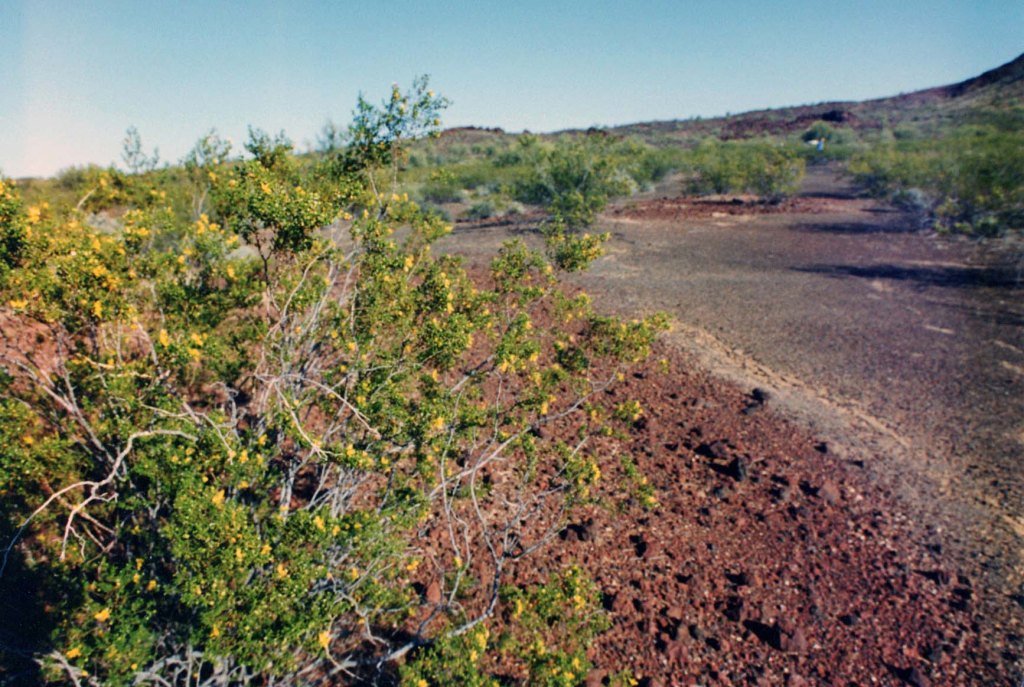
If the Sierra Pinacate were in the U.S., they would be a National Park on a par with Yosemite, Yellowstone, and the Grand Canyon. But they remain relatively obscure, even to Mexicans, languishing as they do in a remote corner of the country over a thousand miles from the populated central valley. For our part, we seem to need resort villages, visitor centers, and a posse of patient rangers.
In those days, Pinacate (the name we used, thinking for some reason in the feminine) was a lot less regulated than she was soon to become. Evidently, the early ‘90s were a transitional moment for her – the Mexicans trying on the one hand to look the other way as contraband flowed to its northwestern border (mostly domestic cannabis and Colombian cocaine) and on the other hand trying to market the little-known national park to the tourists pouring down the U.S. 85-Mex. 8 corridor leading from metro Arizona to Rocky Point, a partyland of shellfish, off-roading, and cheap cerveza. Indeed, she had been a promiscuous mistress to an invading army of small-plane pilots and drug mules, and she’d paid the price in degradation.
Gateway to the Great Desert
On my own maiden voyage into the wilderness, my new friend loaded his two teenage stepsons into the camper shell on the bed of his 4-Runner, while the two of us rode in the cab, comparing notes on an ex-girlfriend we had in common – who, it would seem, had also been a bit free with her affections.
We crossed the border 20 miles south of Yuma, emerging into the central district of San Luis, Rio Colorado, a dusty city of a quarter million. We headed east through the gauntlet of record stores, used-tire peddlers, run-down plazas, and an occasional supermarket. At every four-way stop sign, we could see a block away to our left, the hideous border barrier – a logical reincarnation of surplus Vietnam-era landing strips.

Finally, we accelerated out into the wasteland – to our left the mountains of the Barry Goldwater Bombing Range, to our right the pristine dunes of the Gran Desierto do Altar, which had stymied Father Kino on his first attempt at finding the confluence of the Gila and the Colorado.
No room for error
I assume that Hwy 2 is still a narrow two-lane, raised several feet above the surrounding desert without the luxury of a shoulder. I so hope, though, that it had seen improvements since those days, especially as concerns drainage. In many places where, after a rare monsoon cloudburst, water had come roaring down one of the arroyos from the U.S. side, the pavement was washed completely away, and our jeep had to ease down one side of the break and back up the other.
I can’t really imagine how the commercial buses and the overloaded lorries must have done it. In any case, one could not drive absentmindedly, as evidenced by the ubiquitous roadside shrines.
At regular intervals along the way, a large green sign proudly announced the name of an “ejido” on the south side of the road. But in each case a dirt track, unused for years, led back among the creosote bushes to nothing discernable. In a few cases a block structure, either unfinished or picked clean for materials, stood on a patch of gravel, testifying to someone’s short-lived dream.
I have been told that these are the remnants of some modern version of a communal agricultural system that goes all the way back to the Aztecs. Some bureaucrat had dreamed up a pretext for moving poor families out of the cities and at the same time developing the unwanted countryside. A creditable notion – if there had been any water.

There were only two operating businesses along the entire 120-mile stretch between San Luis and the next border crossing at the historic settlement of Sonoita. One of them was a hacienda-style restaurant at about the midpoint, where the better-off Mexicans could use an actual restroom.
The other was a rustic general store, a shack really, nestled among the boulders at a spot known as Los Vidrios – “the glasses,” after the blanket of shattered bottles that sparkle in the sun on the hillside across the road. Evidently, a soft-drink transport had crashed there long ago, and the name found its way onto the maps.
An alien landscape
Sometime after dark, we turned onto a graded road and followed some dilapidated wooden fencing, meant in theory to contain a scattered herd of bony cattle. The washboard surface gave way to a jeep trail, and soon we were jolting along in the moonlight, alternating between sandy stretches and raised areas of sharp rock, where the wheel tracks could scarcely be made out in the shifting headlights.
The moon was gone by the time we pulled off into an amphitheater of scattered paloverdes and the boys were turned loose from the truck bed.
For some time, I had felt rather than actually seen the dark masses on the right that sometimes loomed up near the road, blocking the myriad stars. Now, by flashlight, I could see the we were in a sheltered area surrounded by black walls frozen into grotesque shapes of rock – impossibly twisted and sharp.
Before we even started unloading, we had to spend half an hour scampering among the outcropping and crevices, watching the jagged shadows play eerily against other mangled sculptures in the crisscrossing beams of our lights.
That night, while the dew fell hard around the column of smoke from our campfire, my friend told stories from history, freely adapting them to modern parlance to the delight of the three teens. I slowly discovered that the boys were of a distinctly disenfranchised variety, raised without much supervision and floundering among the expectations of an inscrutable and competitive culture. I would later learn that the one not related to my friend – a pleasant but basically feral kid with bouncing blond curls – would live only another few months, though I never found out what happened.
In the morning, it was light a long time before the sun finally burned through the fog.
Mouth of the underworld
Knowing that no one would be joining us that day in the lunar vastness, we left the camp set up and took off in the jeep along the off-and-on track. We forked off a few times and finally parked where the road petered out into the side of a hill. We continued on foot and, as we crested the rise, a yawning crater opened up at our feet.
With its raised lip, its sheer walls and its flat bottom, it looked very much like the Meteor Crater in Arizona, only larger. Interestingly, it was formed in a completely different way – by a colossal explosion of trapped steam after rising lava came into contact with groundwater.
I don’t exactly have a fear of heights. I can climb a rickety ladder to the top of a tree, or creep to the edge of a two-thousand-foot cliff; but if I see a youngster do the same thing, an icy spasm grips my bowel. Evidently not so my friend. When the boys asked if there was a way down, he just pointed to an indentation below us in the rock face, and in about ten minutes the three of them were frolicking around on the floor of the crater.
I was to read later that early adventurers had puzzled for years over whether it was even possible to descend without gear, and they had finally concluded that there was exactly one painstaking way in. Fortunately, we were deprived of that scholarly information.
Meet you there
From this higher ground, we had a panoramic view of the massive flow where we had camped. When we’d had enough of the crater, we drove around to a shoulder of the cinder cone that seemed to have given birth to that flow and surveyed it from this new perspective. Across several waves of overlapping lava, we could see the bright colors of our tents shimmering within our little amphitheater through the rising heat, maybe a mile and a half from where we stood.
At the foot of the midsized mountain in front of us, I spotted an intriguing feature, like a giant spattered mud clod. The approach to it was a smooth field of pristine cinders, dotted with a few hardy cholla shrubs; and I felt I could see a clear path, winding through the lavas, from there over to our enclave. So I suggested to the others that I might strike off overland on foot and meet them back at the camp.
My friend, who hadn’t batted an eye when the teenagers descended into the pit of hell, was surprisingly adamant that I, a desert greenhorn, shouldn’t take any such risk. After all, there might be rugged features hidden among the flows that we couldn’t see from here. Besides, the temperature on this February day was probably approaching 90, and we hadn’t brought any water on our daytrip. It looked pretty straightforward to me, though, and I couldn’t be dissuaded.
Water, brother?
Not far into my hike, though, the solitude of the silent landscape quickly descended around me. When I got to the spattered rock at the foot of the mountain, I saw that there was a narrow opening at the center of it, twisting down into the darkness. Not wanting to waste the effort it took to get there, I lowered myself into the tunnel. Nothing much down there, except a thick accumulation of cholla balls, spotlighted here and there by a few slanting rays. Looking back on the escapade after encountering a few rattlers over the years, I’d love to collar that younger me and slap him silly.

Heading back toward camp, I had to cross a few prickly flows, but mostly I followed a network of cinder pathways that wound among upended lava monoliths. As I got closer, I felt more and more indestructible, and finally broke into a jog. Up ahead, I could see my friend heading in to find my bloated corpse. When we met, he silently handed me a glass of water.
At the time, I really didn’t know why he should be so impressed. Of course, I eventually learned, after years of wilderness exploration in varying conditions, that calamity can come quickly, that there is no such thing as a small problem this far from any possible relief, and that even on a fairly mild day in February, the shadowless, shimmering landscape of black sand and even blacker rock speaks silently of the utter domination of the desert sky.

 Sonoran Visions