Following my life-altering introduction to the Pinacates in the winter of ’92, it became a religious observance to make the trip as often as possible – probably two dozen times in the next four years alone.
We would drive to San Luis, Arizona – sometimes buying a couple of days of Mexican auto insurance, sometimes not. We’d make the crossing, perhaps pick up supplies along the polluted strip parallel to the border barrier, and head out into the stark landscape on Hwy. 2 – a lifeline between the nearby population centers of Sonora and the more distant ones of the Mexican mainland on one end, the northwestern border cites and the Baja peninsula on the other.
Occasionally, on a return trip at the edge of town, we had to stop at a Mexican army checkpoint – a token measure for slowing the flow of drugs to the border. Once, in March of ’94 following the assassination of the popular presidential candidate Luis Donaldo Colosio in Tijuana, we passed a caravan of black-and-white Federale sedans heading west – again, a moot show of authority.
After crossing a stretch of barren dunes, the road cleaves a passage between mountain ranges on either side of the border. For eons, large mammals have migrated back and forth across this region with no notion of political jurisdiction. Once, we saw a herd of bighorn sheep following the highway, halfway up the slope to one side. In single file, they appeared as a long chain whose links sought continually to catch up to each other in sudden jerks. It was a sublime sight that I have never seen before or since.
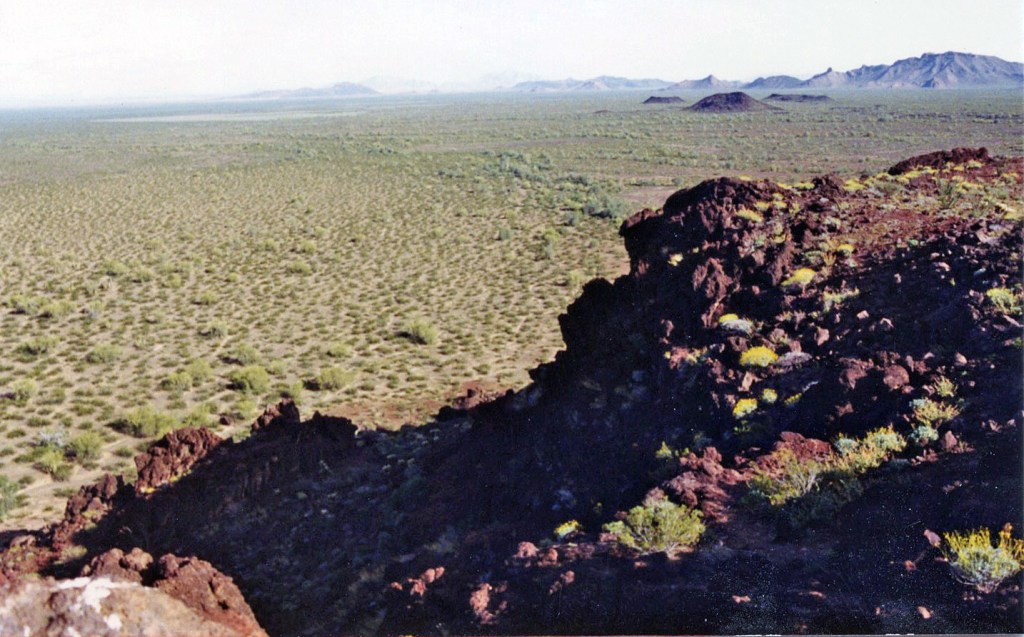
Always, I watched eagerly for the first glimpse of the shield volcano, much farther away than it appeared, with its long tapering profile topped by twin cones. It would be several years before we made it to that remote 4,000-foot summit; meanwhile, we could only dream of its mysteries.
Private entrance
We always entered the Biosphere at the same place – 20 miles shy of Sonoita, where all the American tourists cross the border, brave the gauntlet of souvenir stalls, and pick up Hwy. 8 on their way southwest to Rocky Point. The stretch of desert between Sonoita and the main park entrance is a spectacular example of Sonoran Desert habitat, second only to the Tohono O’odham reservation on the other side of the border.
In those days it was a waste of time to go the long way around since there was no staffed facility anyway and no entrance fee. Later, visitors were expected to check in at the air-conditioned mobile home off of Hwy. 8; they even needed reservations for some destinations in the park. In all those trips, though, I think I came across a ranger twice.

I’m a little afraid to go back now and find the predictable signs explaining the geology and wildlife, the designated parking areas, the crowded vista points. I wouldn’t be surprised if there’s a paved loop linking the prominent features on the desert floor – Suvuk and Tecolote mountains on the east and west, Elegante and Cerro Colorado craters on the south and north.
Of course, that’s all just the price to be paid for preservation and expanded awareness of the wilderness. It’s a lot better than leaving it open to the anarchy of off-roading.
Dammit, I’m Gumby
In hindsight, one of the reasons I stopped going down so often was that the current, perhaps incurable drought of the Western deserts was really starting to be felt. The lushness and rainfall I had experienced at first was transitioning into a baked brown heat, even in those winter months.
During those early years, we seldom saw other visitors – four or five times, in fact, that I can recall. On one of those occasions, a couple of retired naturalists stopped us near the edge of the fresh flows that had spilled out of Tecolote – it might have been the exact spot where we had camped that very first time a year earlier – and pointed out a huge nest high in the embrace of a saguaro only yards from the road. We could see and hear the hatchlings inside, and the adult golden eagles had taken up positions atop a couple of nearby cacti, resentful of our intrusion.
Toward the end of my tenure as a regular guest, two places were becoming the official campgrounds. One of them was a natural amphitheater halfway up the mountain – kind of a staging area for many of the most interesting features. I’ll get to that another time.

The other spot was a sort of cove enclosed by one wing of the Tecolote flows. This flat, open area featured the tallest saguaro I’ve ever seen, a 50-footer with multiple wren holes and a pock-marked trunk, complete with couple of carved Christian names. With its sagging lower limbs, we couldn’t resist dubbing this ancient giant “Gumby,” after the animated character.
Once in a lifetime
Another attraction on the lower plain was one of the few non-volcanic features around, a ridge named Suvuk. We always passed it on the way up to Red Cone, and sometimes camped at the base of its granite flank if we had gotten a late start.
Once, we rested in transit at the mesquite grove next to Suvuk, no doubt wanting simply to prolong our time in the park before the long drive home. As we munched our trailmix we looked over to see a herd of Sonoran pronghorn antelope regarding us intently from a hundred yards away.
They were motionless, but even from this distance we could see the spring-like tension with which they waited to flee at the least hint of a threat. Suffice it to say that we did not move a muscle until they dissolved into the landscape, merging with the sandy washes and ironwoods.

We hadn’t dared even to reach for a camera, but it would be nice now to have proof of that encounter. On a later date, we met a young ranger counting plant specimens beside the road and, when we told her about it, even she looked skeptical.
The species is critically endangered – at one point the estimated population was fewer than a hundred – so it’s possible that we saw most of them all in one place. I read somewhere that the herd had rebounded a bit. But, since they need to range into the Cabeza Pietas in Arizona, a border wall might be the final nail in their coffin.
Surely that qualifies as the most spectacular sight I have ever seen in the wild. Considering where I am in the arc of my life, it probably always will be.
The red crater
The other prominent feature of the northern plain – probably the one visited by the most people and one of the few visible from the peripheral highways – is a very young crater, named Colorado after the deep red it reflects at sunset. It’s basically a giant mud bubble that filled up with steam and popped when magma forced its way toward the surface and vaporized a pool of groundwater, and its relatively soft rim is deeply grooved from erosion.
In those good old days, we used to scamper into the crater from the west side, where the rim is only slightly above the desert floor. We would enter through a small secondary crater and cross to the low point, which in this case is a lush spot mostly in the shade of the steep back wall. On a wet day, there might even be miniature waterfalls trickling in from a couple of the vertical cuts.
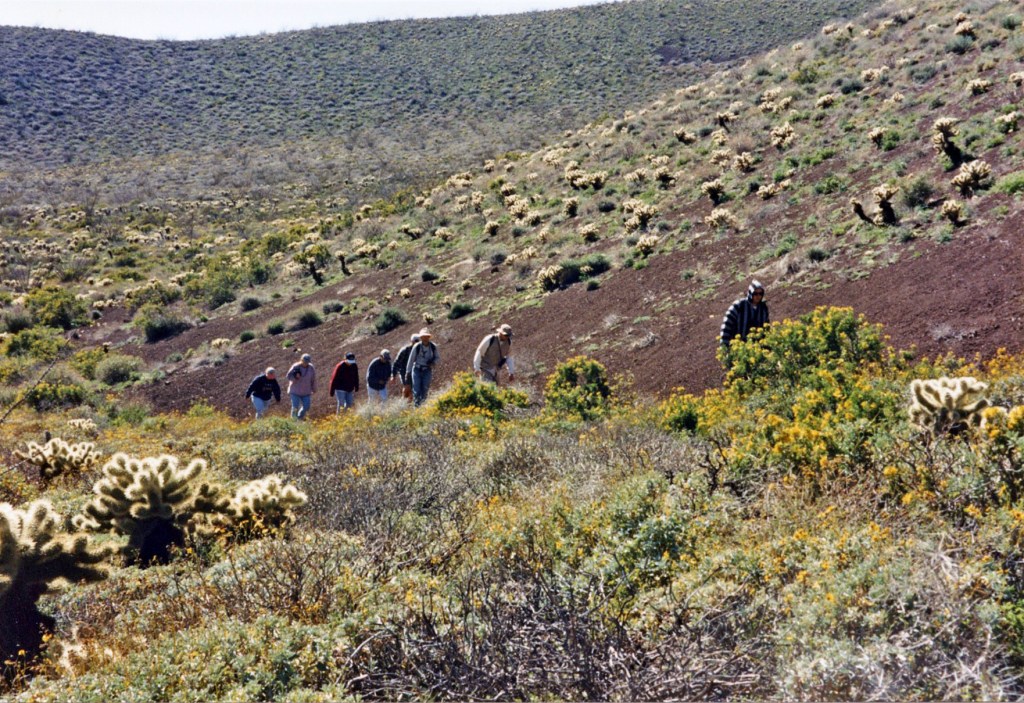
Once, we parked a ways off and approached the crater from across the rock-strewn flats. We climbed along one of the protruding ribs, but the smooth sandstone offered no traction for my soles, and toward the top I honestly believed I would be able to proceed safely neither up nor down.
I survived, apparently, but I’m pretty sure that was when I finally retired my worn-out work boots in favor of a real pair of hikes.
King of the hill
I seem to have some space remaining in this installment for a tribute to the definitive book on the Pinacates – Desert Heart: Chronicles of the Sonoran Desert, by the retired University of Arizona researcher, William K. Hartmann. Many casual visitors to the area know about it, and most devotees have studied it.
Evidently, it was Hartmann’s astronomer’s training that got him interested in the range, which shows up on satellite imagery as a huge black patch not so far from where he lived and worked. After years of research and explorations on foot, the place grew into an obsession as he became one of its chief experts and advocates.
The first half of his book is a detailed history of the area – its explorers going back to the time of the Spanish conquest and its native inhabitants going back much further. There also are several chapters that explain the volcanic processes in clear and lively language.
I had flipped through the book many times over the years, enjoying the stunning photography and useful graphics, but am appalled to realize that I never applied myself to reading it until recently. The Epilogue, one of the most eloquent and passionate arguments for a developing an environmental consciousness, brought tears to my eyes.
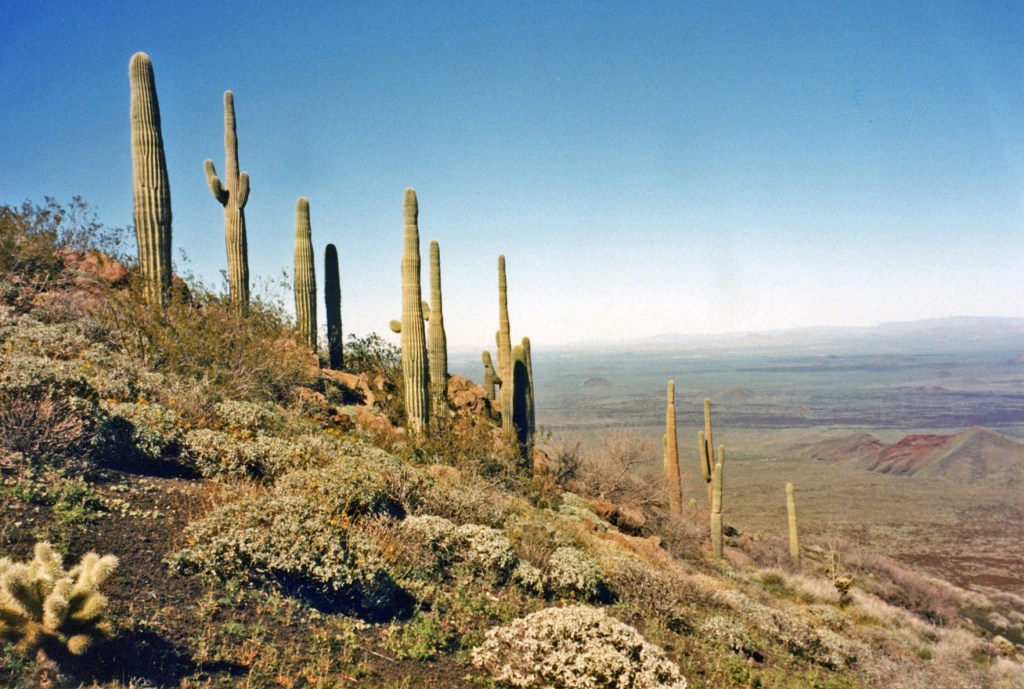
A consciousness of place
In my many years of literary studies, a sense of place was a key concept, and I was temperamentally predisposed to authors and works for whom location was arguably the main character – William Faulkner, Gabriel García Márquez, Leslie Marmon Silko, to name a few.
Eventually, as I came to realize that environmental preservation is the master crusade of the modern age, I began to appropriate the term for a more general philosophical meaning. And I have bumped into a few other academics who have been doing something similar, if tentatively and seemingly in isolation. Now I see that Hartmann – by training a scientist, not a humanist – was using the term in this way some 30 years ago.
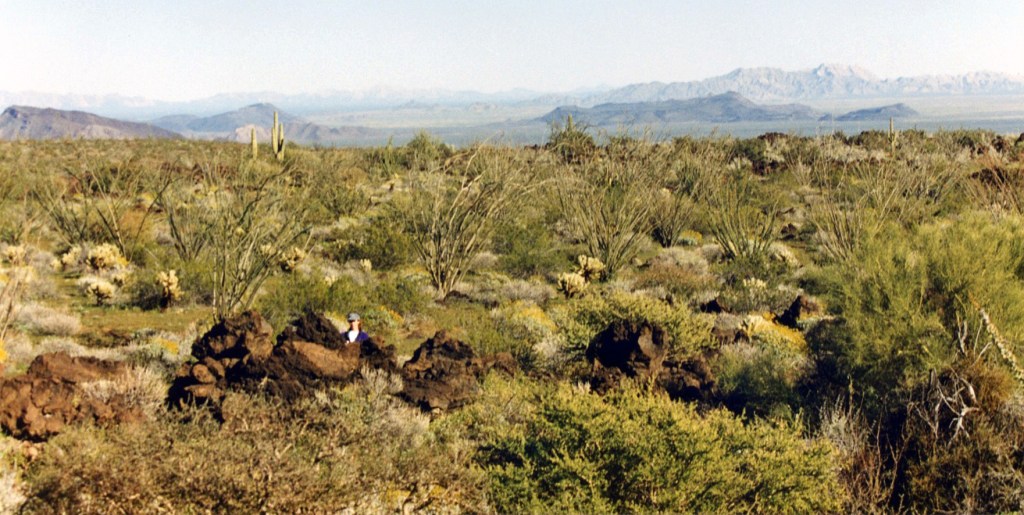
The bad news is that this focal notion is scarcely original to me, as I might have believed, and that I might be discovering yet another symptom of my self-imposed isolation. The good news is that there may well be an entire subculture out there huddled around the belief that revering the surroundings within immediate range of our senses is the most sacred of rituals.
I do know that most of the visitors I have to this sight are people who are showing me a really similar web site of theirs – personal experience narratives by someone in reverence of this fragile, thin layer of balanced, interrelated systems – the skin of an apple – that sustains the only life in the universe we know of.
We are uplifted to the degree that we don’t have to feel so alone.

 Sonoran Visions