As we sped north by northwest away from Kingman, Ariz., a jagged line of black hills slowly began to stand out against the dawn sky. We entertained ourselves with fantasies about the survivalist enclaves that might lie at the end of those graded roads that stabbed into the desert on either side of U.S. 93.
We were on our way to a three-day outing on the Colorado just below Hoover Dam – a stretch of the river called Black Canyon in the lower Lake Mead National Recreation Area. Around sunup, we turned off and followed the steep drainage down to Willow Beach, where we would leave the Jeep and catch a shuttle.
The passenger van with its canoe trailer stood alone in the parking lot, where the other half of our group was milling around looking dazed. They had driven up from Yuma the night before and camped here beside the road, huddling beneath their tarps in the heavy dew.
Our driver, Donna, had been outfitting river trips in this area for a quarter century and had obviously discovered the fountain of youth. During the ride out, she imparted snippets of her encyclopedic local knowledge. For example, those snowcaps to the west were the Spring Mountains outside Las Vegas.
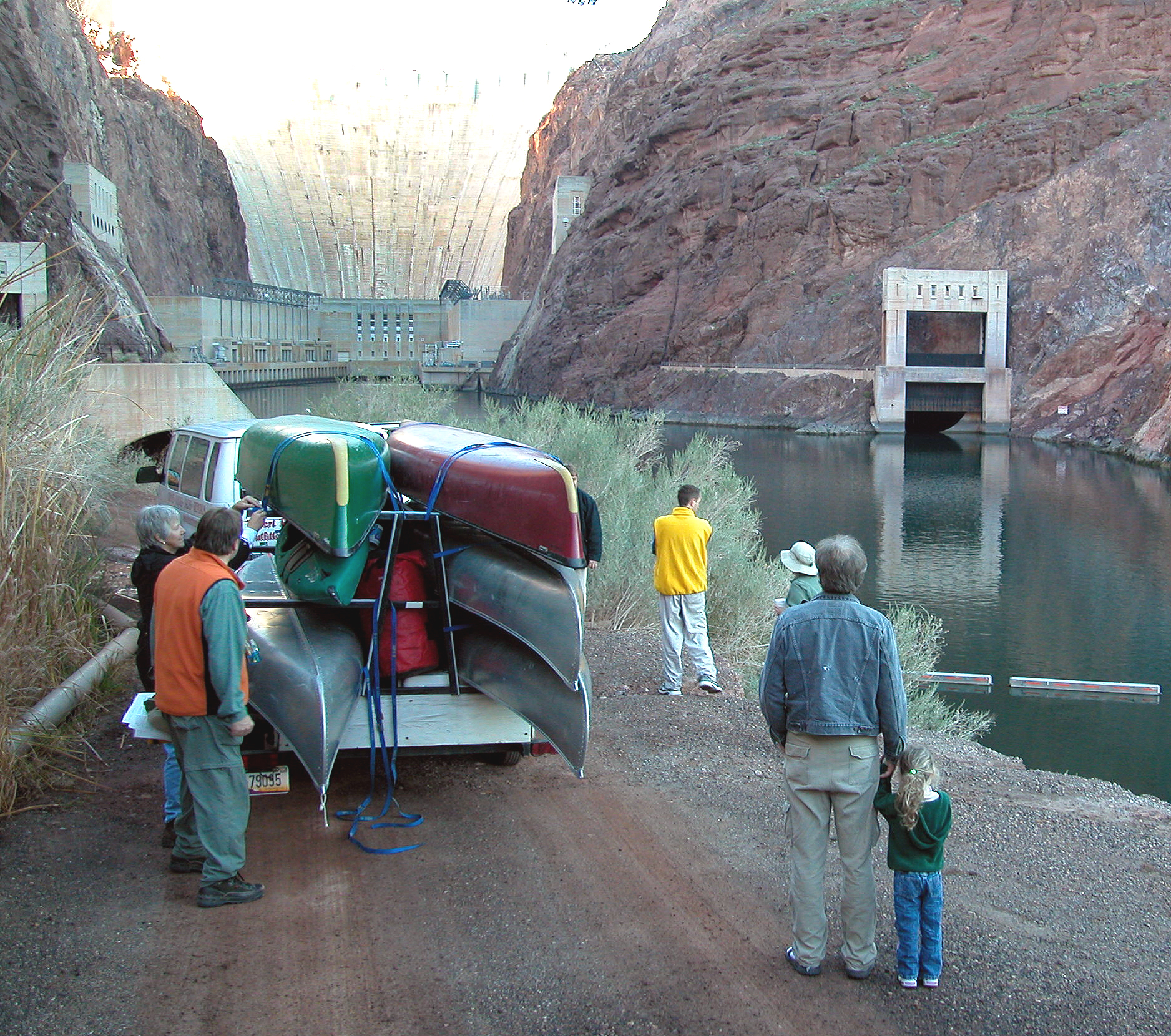
And that new overpass ending in mid-air was the Arizona end of the future bridge to bypass Hoover Dam. We would see shortly that Nevada was lagging far behind on its end, and so far had only leveled the roadbed on the approach to the river. Until the project is finished, travelers would have to pass through the rigorous security check before heading down past the whitewashed maze of the Dam facility.
Down from the dam
At the Hacienda Casino on the Nevada side, we picked up a few other river runners and signed our waivers, then rode back toward the Dam, through a locked gate and down a precarious road to the base of that soaring concrete wall. Donna’s outfitting company, she explained, was one of only two that had permission to use this put-in.
Back and forth across the rocky stretch leading to the water, we unloaded the canoes and enough provisions to live in the wilderness for a month. After extensive negotiations about the distribution of tents, tarps and ice chests, we launched the sturdy aluminum Grummans.
Barely out of sight of the Dam was our first prominent feature – steaming hot springs pouring into the river from the right. This is also where Gold Strike Canyon comes in from the Nevada side.
We beached, and those of us with enough energy and the right footwear scrambled up beside the warm stream, over rock jumbles and a few tricky ledges, using our hiking poles for leverage and trying to keep our photo gear dry.

Only the three most determined of us made it all the way, about a mile up the steep canyon to where two pools are sandbagged. Chaperoned only by whatever bighorn sheep might have been hiding among the crannies above, we set aside our daypacks and our clothes and hopped in.
The upper, smaller pool is probably 112º F – too hot to tolerate for long. The lower one is much more comfortable, but a slimy silt lines the bottom. Those in the know say that you’re not to submerge your head in these springs because of an exotic bacterium that can enter through the nose and cause encephalitis.
While my two companions were soaking, I scouted around. Just above the pools the spring water was no longer aboveground. Farther up, the canyon made a sharp left through a narrow slot. Until recently, this was a hiking trail that led down from the Boulder road, but the big overpass project had closed it off.
Wilderness night life
Our destination for Day One was Arizona Hot Springs, that baptismal shrine of hot-tubbing enthusiasts throughout the Colorado Plateau. The paddle down to the camping beach below the Springs was four miles out of the total 15 down to Willow Beach.
Held back by Davis Dam down by Bullhead City, the Colorado isn’t really flowing here, so we were moving on our own steam. We quickly worked up a sweat in our lifejackets, and the dark water looked inviting. But Mojave Lake is simply too cold for swimming, especially in the cooler months. The water that flows into it comes from the lower levels of Lake Mead above and then is shaded by the high, sheer walls of Black Canyon.
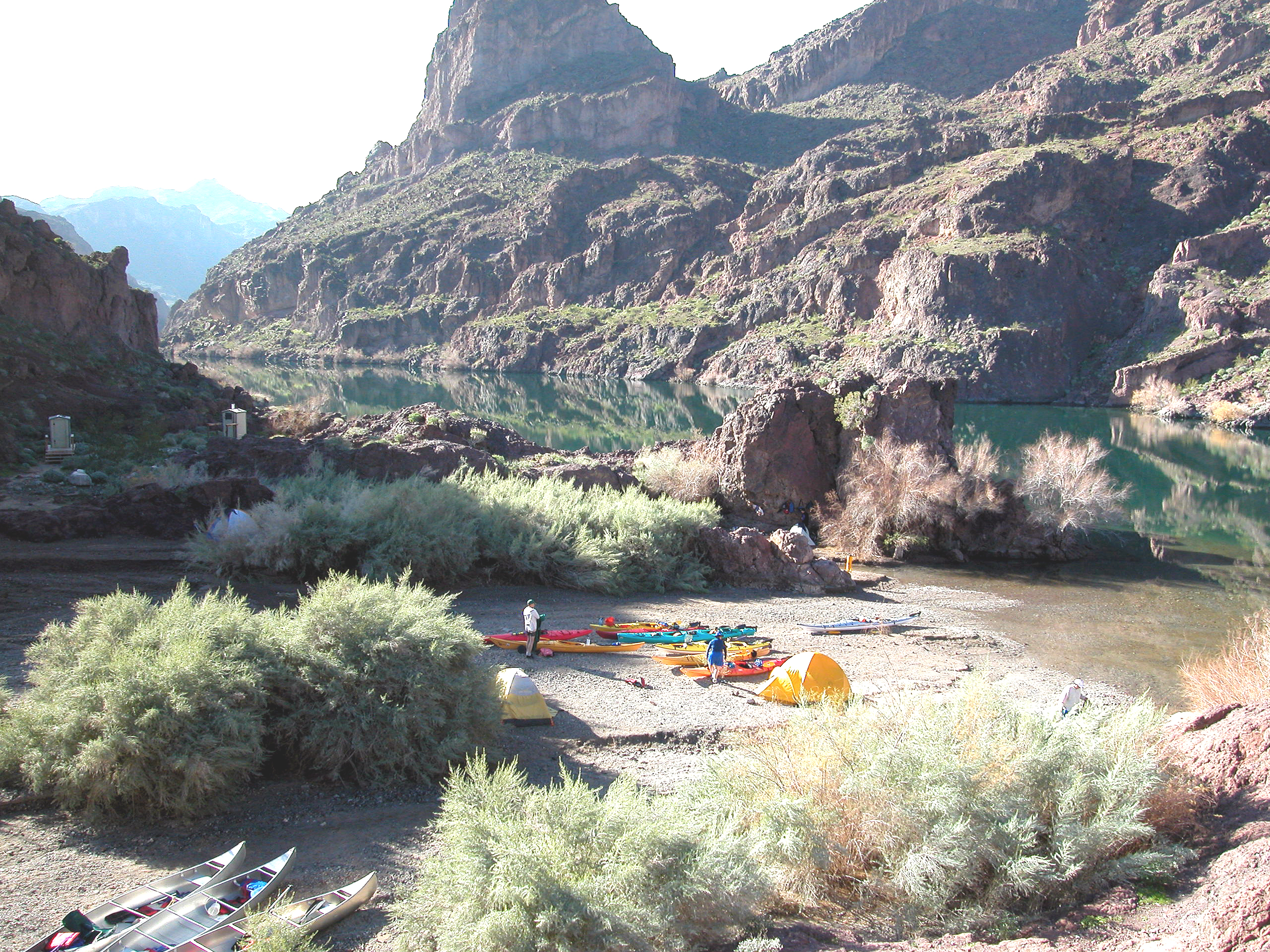
By mid-afternoon, we reached the Arizona Hot Springs site, one of the largest beach areas in the Canyon. In fact, it’s the only place with a couple of portable toilets – a necessity for the many tent campers who spread out among the myriad cuts and box canyons that converge here. Not the safest situation in a flash flood, we mused.
It was my night to cook. And afterward, since I’d had my fun back at Gold Strike, I got parenting duty while the social butterflies headed up the wash to savor the starlit skinny-dipping scene.
Revelers migrate from Las Vegas and even from L.A. to enjoy the famous spring, especially on weekends. As usual, some had made the three-hour hike down during the day, and some of them would hike back out in the moonlight, fueled by a few beers. Later on, I’d get the blow-by-blow, complete with the pseudonyms my friends had come up with for the various hot-spring denizens – Mr. Lonely Kayaker Man, Big Hat Vegas Hustler, and Old Muscular Shovel Guy, who was busy repairing leaks in the sand-bag wall.
A view from the rim
The morning highlight was the bighorns that kept coming out to the edge of the cliffs above to check us out.

Eventually I got around to making the beautiful quarter-mile hike up to the hot spring. I had to be creative in picking a path along the beautiful slot canyon since the water that soaks the sand there is too hot for bare feet.

A 15-foot ladder – sure to limit alcohol consumption – leads up to a narrow neck where the two pools are kept full behind sandbags. The lower pool is just about the size and temperature of a jumbo hot tub while the upper, only a foot or two deep, is very hot.
For the next hour or so, various groups came and went – Hispanic families, foreign hostellers, nudist stoners. At one point, the big tub was taken over by a party of three professional couples, dabblers in the New Age, one-upping each other with obscure references to karma and quantum physics. All of them, it seemed, had been to Machu Picchu multiple times recently. One of them, John, had even met his wife there – Genevieve – who (I wouldn’t lie about a thing like this) actually wanted everyone to pronounce her name the French way.
Having had enough for one day of scalding water and high culture, I got out to scout around. It turns out that the spring originates just above the pools, at the head of the slot canyon. Above that, I came out into the open on what must be the plateau above the river. I climbed up around the ridge and had an unobstructed view for miles up and down the river. I stood for a long time watching a fleet of kayaks floating down from the Dam.
Michael, row your boat ashore
We figured we’d better log a few miles that afternoon, so we loaded up and launched. We kept up a good pace, except when we drifted to snack on exotic cheeses and wafers from Trader Joe’s or to watch the wildlife up along the canyon walls.
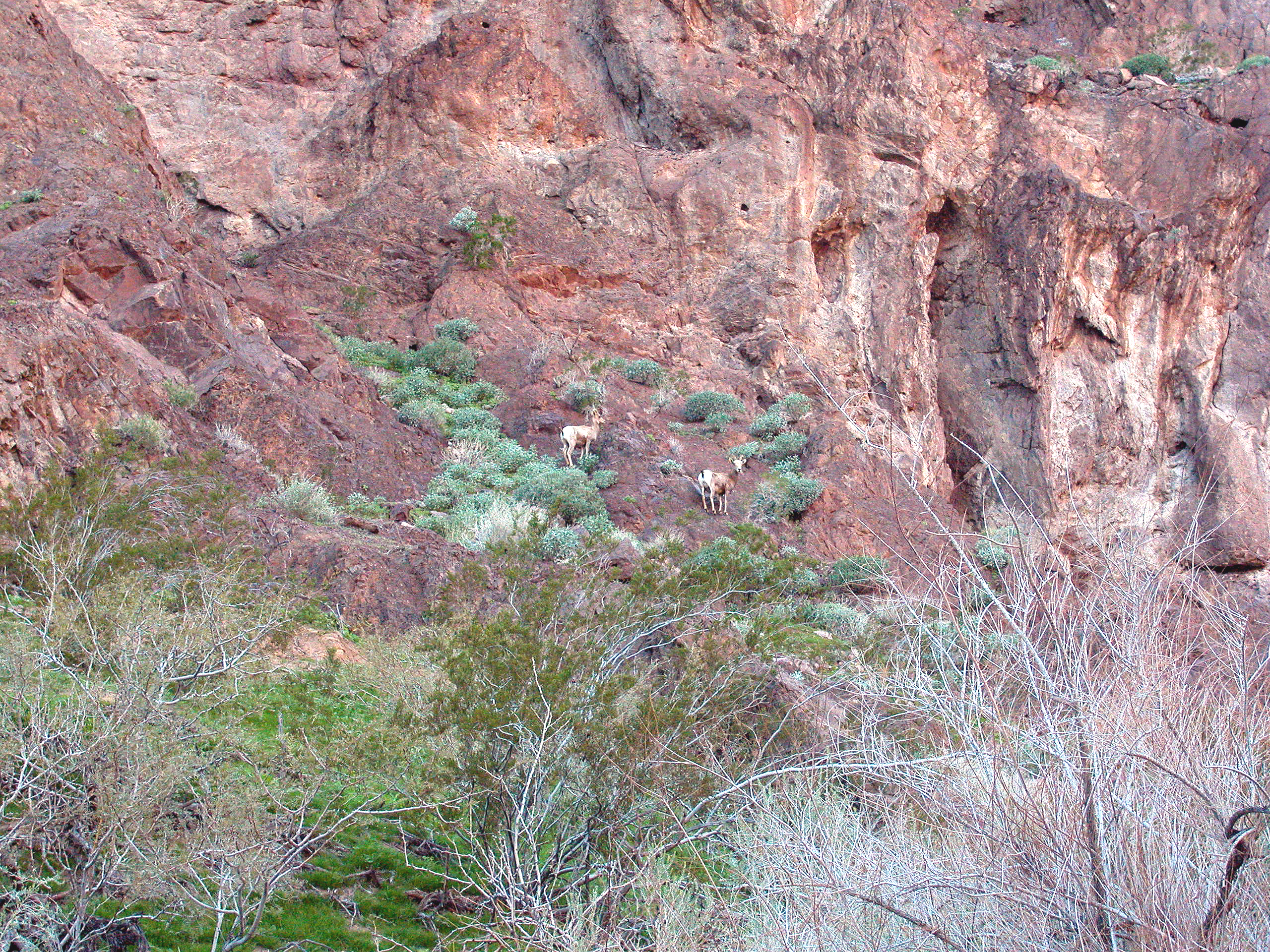
At one point we spotted a bighorn ram with two ewes, at another point three ewes and a lamb – which scampered around dislodging rocks and no doubt making its mother cringe. It was such a rare sight I didn’t even dare rattle my ammo box to pull out the camera.
When we realized darkness had nearly descended on us, we started looking seriously for a camping beach. Regrettably, we passed up a beautiful sheltered wash in favor of logging one more mile – up to the next square green marker, we said – so as not to have so far to go on the last day.
But the only beach ahead of us already had a group of about 30 Boy Scouts. The campsites were rocky, but the company turned out to be fun. The boys stayed up late around a big fire, learning poker games from their scoutmaster. They all fell in love with our four-year-old, Mary, and vice versa. A preview of the years to come.
Home stretch

The next morning, we passed the defunct gauging station dating from the early days before Davis Dam. Leading away from it was a catwalk that clung precariously to the rock face. And soon we were out of Black Canyon.
Toward the end, we were feeling the effects of the workout. But I still stubbornly wasted energy in pursuit of the Great American Wildlife Photo. I cornered one especially shy group of ducks in a cove, only to see them escape at the far end of the thicket, pounding the water with their wings.

In our favor, the lake had been mostly flat and calm. We’d had the good luck of encountering no motorized craft on the three-day trip, but that’s because only canoes and kayaks are allowed above Willow Beach on weekends and holidays.
Toward noon, a little headwind picked up, so we hugged the shore to stay in the lee of the rock walls. Finally, though, we were entirely in the open, and the last stretch heading toward the houseboat marina seemed endless. One of our group, an English professor, had some creative ways of referring to the cramped conditions in the bow of the canoe.Back in the air-conditioned comfort of the Willow Beach convenience store, the new manager told us his scheme of ferrying canoes upriver to the Dam on the designated days. We’re at the top of his waitlist for next year.

 Sonoran Visions