On the third day of our trip down the peninsula, we woke up on the lovely crescent beach at Bahia de Los Angeles. We paid a local girl to put cornrows in little Mary’s hair, to save us the trouble of brushing for the rest of the trip, then we broke camp and headed over to the nearby tortoise sanctuary, which appeared to be occupied by neither man nor beast.
In town, we spent an hour at the quaint museum of maritime artifacts and oddities, then headed back up the slope away from the coast. This road is one of the few spurs off of Hwy 1 that is paved. Within just a few miles, though, we turned off on the first of our unpaved side trips.
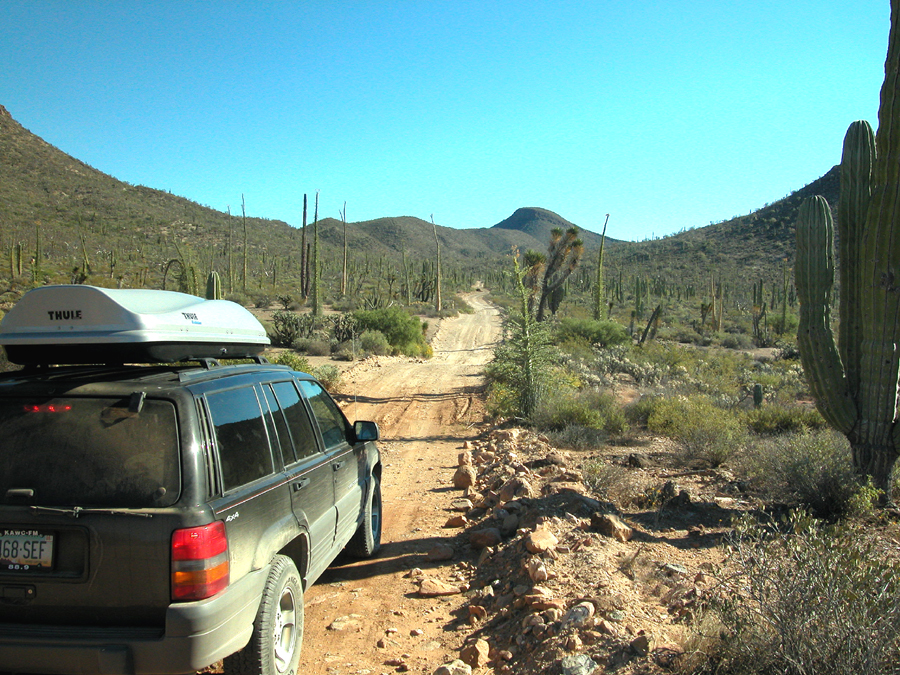
Off the blacktop
The desert on the way down to the Mission San Borja is lush with the unearthly ciria trees, yuccas, cholla, elephant trees and giant cordon cacti. Down a remote side road are the Pinturas de Montevideo – a collection of varicolored abstract symbols painted by an ancient indigenous people along a volcanic wall.
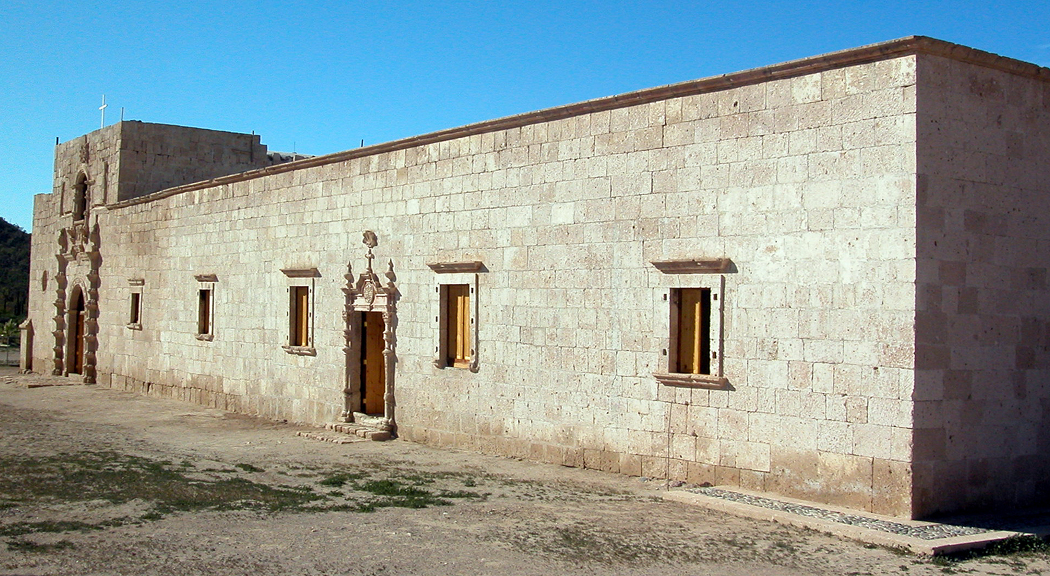
After several hours, two mountain passes and no sign of another human being, we finally came to the Mission, nestled in a wooded valley. The foundation of the original structure is still there beneath a rigid awning and beside it the rebuilt mission from 1742, which still hosts mass once a month, when the priest makes it out that way.
Gabriel, the youth who showed us around, was descended from the native population to whom the Jesuits had brought their religion. Gabriel gestured to an area below the church, saying that two thousand of his ancestors had been buried there in a single year after their encounter with another gift from the Old World – smallpox. This was a story that had unfolded all along the coast; all but a couple of the missions had been abandoned within a few years of being built, for lack of a congregation.
Nearby, a young American couple was resting in the shade of one of the palapas. They told us not to come too close because they thought they had the flu, but we suspected an attack of Montezuma’s Revenge. We ate our lunch a couple of palapas over, with the entire family of caretakers regarding us innocently.
We hit the trans-peninsular highway again at a dusty village called Rosarito, and headed south to Guerrero Negro, home to the world’s largest evaporative salt works and, in winter, to nearly the entire West Coast population of gray whales. The birthing season was still a week or two away; we would try to catch that on the way back.
A squatter’s paradise
In the morning a thick fog lay over the coastal plain, and we drove inland through an alien landscape of lush desert flora that rivals anything else in the Sonoran Desert.

In the center of the peninsula is the lovely town of San Ignacio with its beautiful white mission, set above a grove of date palms. From the staff at the state museum, we gathered information about the remote caves full of Indian art that we planned to visit on the way back. On the concrete plaza, we played frisbee with a group of local kids until it was too dark to see.

Next day, on the road to the east, we passed Tres Virgenes, a trio of pristine volcanic peaks. The highway hits the coast at Santa Rosalia, one of two ports for the ferries from the mainland.

It’s a former French outpost, established by the Rothschilds for the export of copper. The spacious houses here, built of Oregon pine, are unique on the peninsula. The prefab galvanized-iron church, in fact, was designed by the immortal Alexandre Eiffel for the 1889 World’s Fair.
We pressed on beyond Mulejé, an hour to the south. Lori had a certain location in mind from her trip a dozen years earlier, but near one community of beach houses a row of dome-shaped palapas caught our eye. The place turned out to be abandoned, fleet of kayaks and all, the owner having absconded to Thailand with his new wife. But we found several groups of Americans squatting in the spacious palapas, so we joined the party.
Our neighbors were a motley collection of mavericks and misfits, the elder being a scruffy mystic who had hitchhiked all the way down from the Olympic Peninsula with his hippy girlfriend and arrived a week earlier.
A gypsy anarchist from Oregon, who actually parked his camper just off the grounds, was the self-appointed caretaker, maintaining the toilet and periodically dredging the natural hot spring marked by a circle of stones out on the tidal flat. Jim believed he had a ringside seat for the Apocalypse from the sliding door of his van.
Coincidentally, there were two gay couples from the Bay Area, one male and one female. And there was a group of stoners on a quest for the perfect surfing wave. There were average Joes, too, like the couple from L.A. – a Japanese-Canadian father and his brother, his wife the film editor and their adopted Chinese daughter.
The composite crew made for great company around the barbecue pit under the waxing moon. Breakfast and lunch were bought cheap from a guy who wandered back and forth on the beach with a bag full of tamales and burritos.
On the second day we took a side trip back to Mulejé to stock up on provisions and visit the mission, a unique structure made of the characteristic round stones of the area. There we met a couple from New Jersey who had been married in that chapel twenty years earlier.

For the rest of the time at our hostel-by-the-sea, which we dubbed Eco Mundo, we paddled the high-end kayaks out to the nearby islands, played tag with the pelicans and sipped Tecate with our new best friends.
The landed gentry in the neighboring community didn’t much appreciate the squatters, of course, and conspired to take their daily strolls along our stretch of beach, making loud, snide remarks. The atmosphere was gradually getting tense, so after two days we reluctantly pulled away from our unauthorized paradise.
Toward a new year
The next stop, Loreto, is one of the more cultured cities on the peninsula, with art galleries, fine dining and an elegant mission. We hooked up with a classy young American couple, and together we looked into some options for eco-tourism, only to decide it would be too expensive and too time consuming.

The young man was a genetic engineer, engaged in a government project to help indigenous farmers in the state of Oaxaca to map the genes of certain hardy varieties of corn. I was relieved to learn that the Indians would retain the patent.
Lori and I made a tentative offer to drive our new friends out to the old Mission San Javier the next day. But, after a night of brainstorming, agreed we would have to disappoint them as our itinerary demanded we press on and make that side trip on the way back.
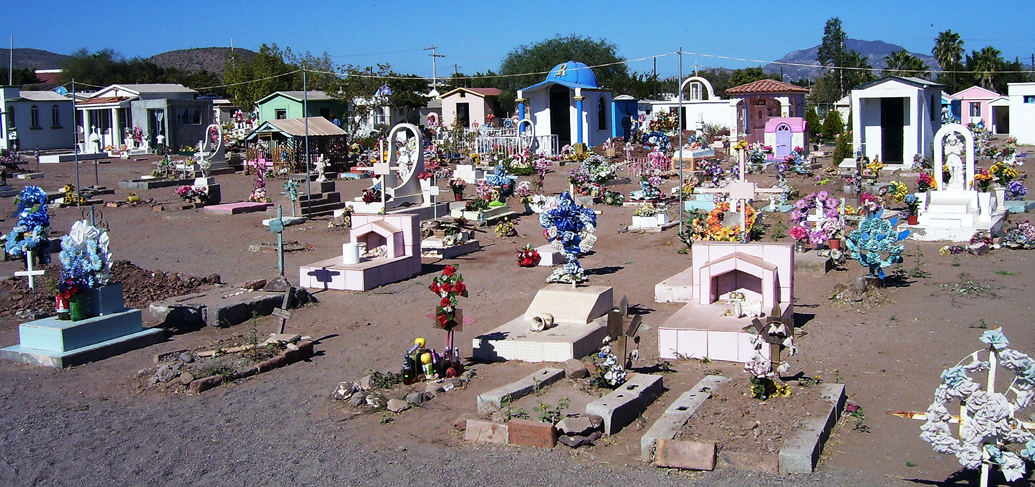
We pushed off very early. On the outskirts of town, we saw a cemetery of brightly painted mausolea and resolved to explore that too on the return trip.
The coast below Loreto must be the prettiest on the whole trip – mountains on the right, crescent beaches and hidden coves on the left. After a particularly hair-raising stretch along the cliffs, the road turns inland. We had about four hundred miles to make that day; fortunately, the flat highway and the glorious weather could accommodate a serious pace.
We had thought we would stop and explore La Paz, but we found it to be a pretty typical crowded, smoky Mexican metropolis, with endless expanding suburbs. We stopped at an internet café to check email and write a couple of blogs. The service in such places is generally dial-up, so we had time to do our laundry, too – in the same establishment.

Spontaneously, we pushed on to a remote solar community on the coast called Cabo Pulmo. That night in the larger of the two restaurants, we ran into our multi-ethnic L.A. friends from Eco Mundo. They had hooked up with a couple of vintage hipsters from Northern California, who also had adopted an Asian daughter of about the same age.
I had a long talk with Raj, as he called himself, and it turned out that he had been a follower of the Indian guru Rajneesh, who had led an ill-fated commune in the early ‘80s. I made note of the fact that he seemed amazingly level-headed – in sharp contrast to the contemporary press coverage of the phenomenon.
We slept hard that night in our quaint thatched-roof cottage, to the occasional sound of New Year’s fireworks.
***
This story previously appeared in the January 25, 2009 edition of The Sun (Yuma, Az)

 Sonoran Visions