A late, mid-March cold front had left a cap of snow on the Chiricahua Mountains, one of the “sky islands” dotting the Sonoran Desert of southeastern Arizona. A high-pressure system to the east had created a “wall,” trapping moisture over the desert for days.
So our long-planned camping trip was a little wetter than expected, with glimpses of sun between the squalls that rolled in from Mexico-way, alternating drizzle and sleet.
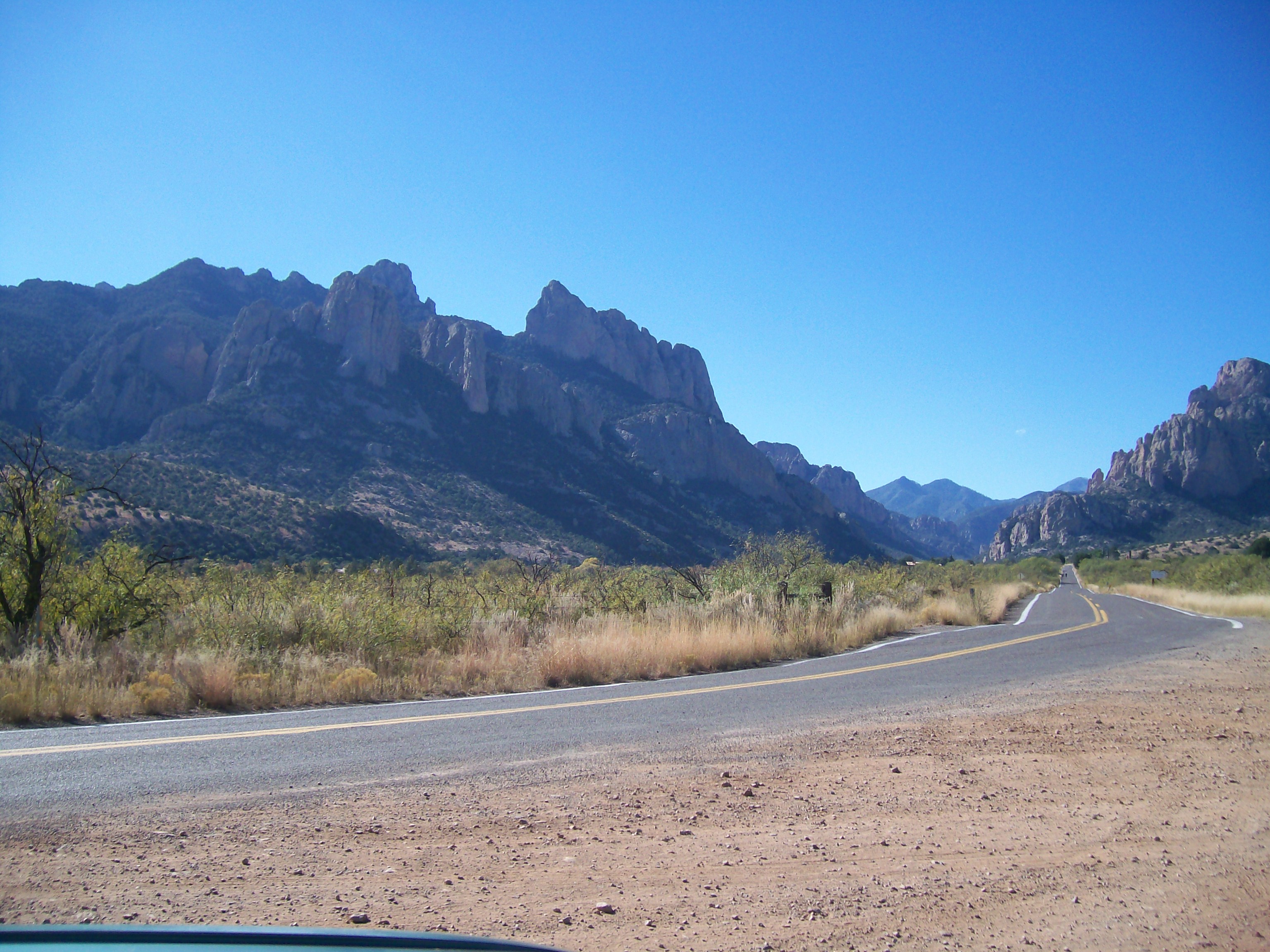
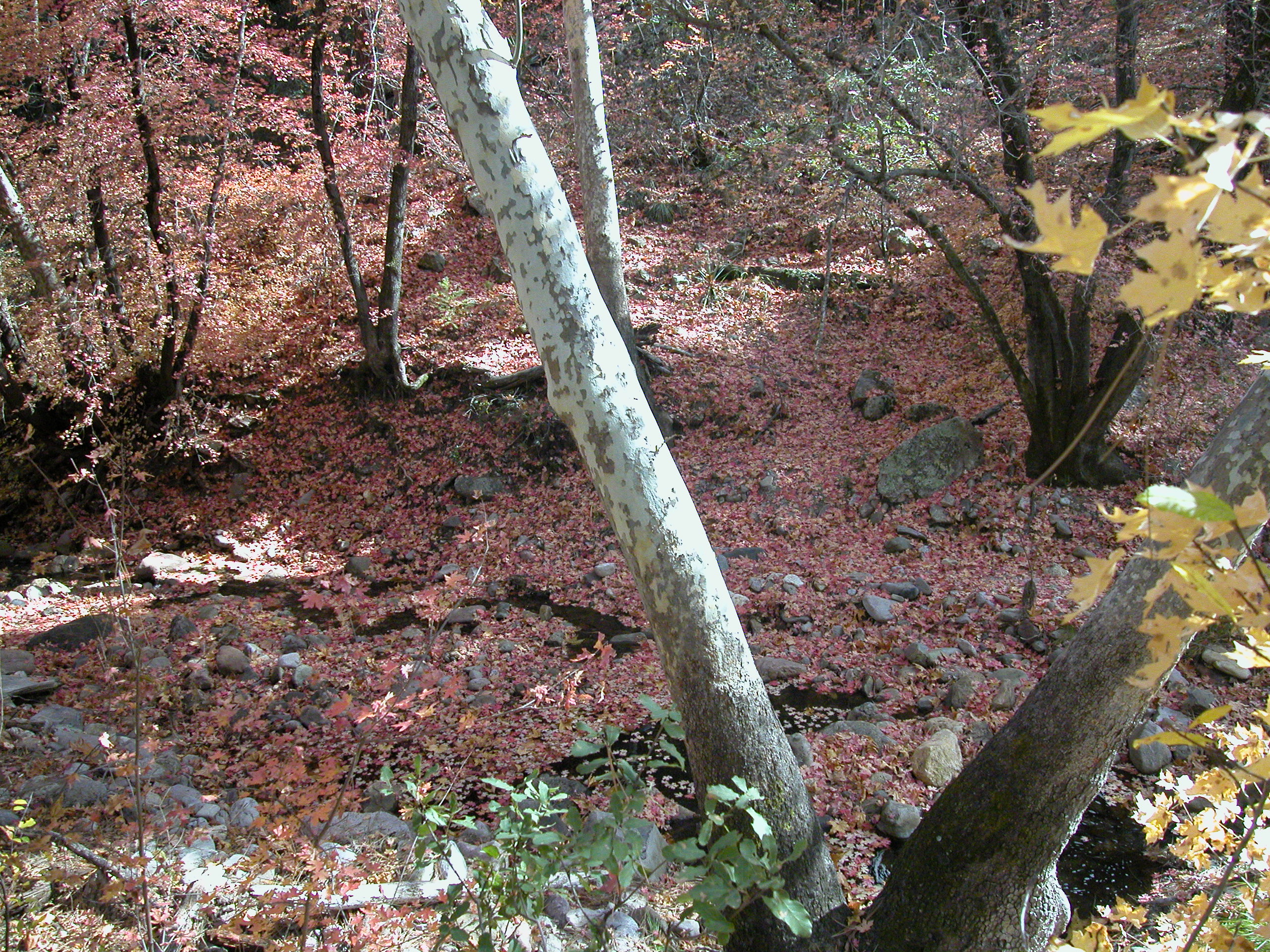
On the bright side, all the creeks were running, which is a special treat you can go years without getting in Arizona. And the weather had discouraged all the usual weekenders, so we had an entire wilderness to ourselves, except for a healthy population of wild turkeys, recently reintroduced into the area.
And except for this one old-timer, Ron White, who drove in after dark on Saturday, pulling his 22-foot trailer behind an old Ford pickup. A disabled Korean War vet, Ron had been roughing it like this for 40 years, he said. Turkey Creek, a no-fee campground, was a two-week stopover for him on any east-west road trip.
He knew all about the area: the history (Geronimo and his warriors could’ve survived in here indefinitely; the Army must’ve taken their families hostage); the geology (the Turkey Creek Caldera eruption 27 million years ago was 1,000 times greater than the 1980 eruption of Mount St. Helens); the biology (this is the northern end of the habitat corridor for El Tigre, the elusive American jaguar, largest cat in the Western Hemisphere); the facilities (the Southwestern Research Center of the American Museum of Natural History in Cave Creek Canyon is one of the premier locations in the world for the study of migratory birds).
And Ron knew all 111 miles of hiking trails webbing this range – the moderate, the difficult and the impossible. Once he had set off from here by himself and hiked the mountain trails all the way to Heber, a few hundred miles away on the Mogollon Rim.
“That was when I finally ran out of steam – August of 2002,” he said, stroking his long beard and squinting his one good eye meaningfully.
Otherwise he’d be up on the Turkey Creek Ridge trail right now, a steep, rocky climb that finally dropped down into Mormon Creek Canyon from a narrow saddle among the peaks.
My face must’ve showed some interest, because he said, “If you were going to do that, you’d already have to be started.” That was about 8:00 a.m.
Long story short, around noon I decided to see how far I could get anyway. My group had hiked up a gentle trail to Mormon Spring, which fanned out across a stunning miniature meadow of pampas grass and what looked like giant lilies about to burst into bloom.
Everyone else wanted to go back to camp, slowed down by toddlers and sore quadriceps. I was tempted, too, by the thought of a lazy afternoon under the giant sycamores, eating gouda and smoked oysters down by the waterfall, then booting the nerf ball around till the kids crawled into the pop-up trailer for a nap.
But, I reasoned, it was getting toward the end of the hiking season in Arizona, and I had fallen far short of my outdoor quota. It was a six-hour drive from Yuma to here, and when I got home I’d be facing a six-month sentence in the air conditioning, cowering from the heat.

So I filled my water bottle at the spring and swapped some gear – for example, the plastic garbage bag I was wearing in exchange for my wife’s padded slicker. I gave instructions to turn on the two-way radio around 5:00, just in case I was stuck and happened to be in range. And by the way I’d probably be all right even if I got stuck out there overnight.
I don’t know what I was expecting, but Mormon Creek Canyon went on and on and on. I kept myself distracted from the steady uphill slog by studying the precious, pristine water – the way another spring bubbling up from the deep shadows directly under the roots of a tree (I could’ve crawled in) and the way the stream seemed to dry up but then was back on the surface farther uphill.
The gnarled oaks gradually gave way to aspen groves, the aspen to ponderosa pine. I pushed forward between old rockslides and occasional sheer rock faces on both sides. I knew that, although the mountains kept rising up out of sight on my right, this watershed eventually would slope up to the level of the ridge I kept glimpsing off and on high above me to the left.
I was getting lightheaded, partly from the effort and partly from the thinner air (the trailhead below the campsite is at 6,200 feet). The work grew harder still when I got high enough to start slipping a little on the fresh sleet. The whole way I had been hit by little bursts of rain, then sleet, and finally wet snow.
I came to a place where dozens of giant ponderosas lay crisscrossed on top of each other, blocking any reasonable passage up the draw. No trail could be seen beneath the snow, which at this altitude blanketed both slopes of the canyon, having accumulated over several days in the dense shade.
I was determined to extend my privileged moment before I started back, so I got out my lunch of peanut butter snacks. There was no dry place to sit, so I stood there counting the reasons I shouldn’t keep pushing for that elusive saddle.
First of all, I was violating the cardinal rule of outdoorsmanship by hiking alone. All I had to do was turn my ankle and I was up the proverbial creek.
Not having planned to make this hike, I had not brought the essential gear, not even gloves. My boots were already soaked (of course I had neglected to waterproof them this year). The one thing I did have was my telescoping walking stick (thanks to my laziness, I hadn’t taken off the snow basket yet).
For any normal conditions, I didn’t have a fraction of the water I needed, though as it was I could eat snow. (The creek had long since disappeared from view.)
Of course I had been dreaming when I thought I could survive overnight if necessary. Nightfall would bring freezing temperatures and I had no matches, not that there was anything dry to burn. Since I had never been here before, I had no idea how long it would take to get back using the longer ridge trail (it was now mid-afternoon).
The signal of my overrated two-way radio would never reach out of these hills, even if I could condone anyone trying to come after me in the dark. The full moon would be obscured by clouds.
And what if I did make it up to the saddle? I’d just have to guess where the trail was until I got down out of the snow.
Then there were the big animals. Around here there was enough concern about bears to have heavy metal boxes at all the campgrounds for depositing garbage and storing food. Ron White had told me a story about watching a bear rip the side off a van for fresh meat.
And mountain lions. Just this weekend Sabino Canyon near Tucson had reopened to the public after a two-week closure following a rash of sightings. Say a cold, hungry cat chanced upon me while out stalking one of the white-tail deer whose tracks were everywhere; it would easily see that I was sluggish and exhausted. Would my metal pole be any use . . . ?
But after a short rest and some nourishment, I finally had a second wind. Obviously I shouldn’t try to go forward, but maybe I could cut back cross country (another wilderness no-no – I’d gotten myself into trouble countless times that way) and find the ridge (it must be over there somewhere).
Just as I was starting off through the snow, I stumbled on what must be the trail. I followed it. It started switching back and forth through thicker trees. The snow got deeper; the slope got steeper.
Finally, I lost the trail for real. The falling snow was real now, too, with big dry flakes. But by then I was sure I must be close to the saddle. For the last few hundred yards I sidestepped up the slope, knee deep in virgin drifts.
At the top was a line of footprints, grooved in the snow. Someone had come up the ridge trail in the last day or so and continued among the trees on their way toward the peaks. I had a moment of temptation, but only a moment. Any other day . . .
I went to the edge of the saddle. The other side, sloping away sharply, was bare except for the spires of pines killed by fire.
Just then the clouds lifted, and I was looking across at the bare face of the main ridge. In front of me was the 25,000 acres of the 1994 Rattlesnake Fire, which had swept up this entire basin and stopped at the top, leaving a line of giant, healthy trees silhouetted against the sky.
That row of summits, at nearly 10,000 feet, was just a little higher than where I stood, but it was above the melt line. Even from maybe two miles away, I could see the gusting wind lift the powdery snow from the branches and send it swirling out over the bleak canyon. The mood was palpable.

Having found the trail, I figured I wouldn’t have any trouble getting back before nightfall. Still, I couldn’t resist running for most of the way. Since I was following the ridge, the slope was almost imperceptible, and the heavy snow was like a layer of cotton.
One set of prints was of huge paws. No doubt my compatriot the hiker had brought his St. Bernard, but I entertained myself with the idea that a puma had stalked him. I watched for the scene of ambush, the trail of blood in the snow. I refilled my water bottle at one of the last patches.
Whenever a bank of clouds passed, I stopped to take in the view, which at times extended far out into the basin to the west – a patchwork of shadows from the passing squalls. From one vantage, I could see all the way to the blond jumble of the Dragoon Mountains, stronghold of that other great Apache, Cochise.
I even thought I could pick out the Barfoot lookout tower farther down the Chiricahua range, where I had stood against the cold wind and watched the sun set over the Dragoons last November.
Eventually, beyond some low hills to the north, I located a corner of that wonderland the Indians had called “The Land of Standing-Up Rocks,” in the world-famous Chiricahua National Monument.
All the while, in the stillness I could hear Mormon Creek rushing far below.
Finally, in early evening, across the bower where Mormon Creek empties into Turkey Creek, I saw the smoke from two campfires go up like twin signals. No doubt the firewood was a little soggy.
At that moment the sun came out. At just the right angle, it refracted off every raindrop balanced on every leaf across the valley, and the whole slope lit up like a sea of tinsel.
A little later yet another dark cloud loomed over the mountain. I decided to cut off the last mile by angling down the slope of the ridge among the scrubby oaks. The moment I crossed the stream into the campground, a hailstorm drove us all into the trailer.
The next morning Ron White and I marveled at the ice balls that still filled the bed of his pickup. He told me a few more yarns, and I told him mine.
“Feels good, don’t it?” he said.

 Sonoran Visions