As the last glaring hole in our exploration of Yuma County over the past two decades, our trip down Big Eye Mine Road this spring was special. It was special also because it was a camping reunion with an old friend who’s been making excuses for several years about not getting out to the desert.
On what we accurately predicted would be the last cool weekend of the year (that is, below 90°), the five of us piled into the Jeep – Lori and myself with our six-year-old, and Carol with her eight-year-old – the ice chest full of food, the hatch stuffed with camping gear and a generous load of mesquite branches rattling overhead on the luggage rack.
We headed north on U.S. 95, past the familiar pair of Howitzers that mark the entrance to the Yuma Proving Ground, and took the right fork on Castle Dome Mine Road, 30 miles from town, which leads straight toward the landmark square plug.
As always, we passed a few hundred yards to the east of the anchor pad for the remote-controlled white balloon that soars 10,000 feet above the desert floor. It is the westernmost of 11 such tethered Aerostat Radar Systems – sometimes called “Fat Alberts” – spaced evenly along the southern border all the way to Puerto Rico. This high-tech spy machine is not, however, what Big Eye Mine is named for after all.
The road less traveled

After a couple of miles, the pavement gives way to dirt. After another six, nearing the massive wall of the Castle Dome range, the adventurer has the clear choice of turning northwest, past the Castle Dome Mine museum and on toward McPherson Pass, or southeast onto Big Eye Mine Road. This time, we took the road less traveled.
The 10 miles up to this fork had taken us about a quarter of an hour; the 15 miles out to the end of Big Eye Mine Road would take us another two. But that’s partly because we kept stopping to ogle the desert blossoms – the white of the giant saguaros, the yellow of the spidery paloverdes, the fuchsia of the clustered prickly pear cactus – and the surreal rock formations.

Also, Big Eye Mine Road is rougher than your average fare. In all these years of bumping around in the desert, I’ve hardly ever had to use my four-wheel drive, and I wouldn’t need it here. What I would need was my high clearance. There’s one climb up out of a wash that would turn back some of the cockiest off-roaders.
The road also is a really roundabout way to cover three or four miles as the crow flies. There were times along the way when it carried us due south. But eventually it curved all the way around to the north, into what is called Slumgullion Pass. Finally, we settled into a deep wash that climbed into a vast basin surrounded by high peaks, and we ended up pointing northwest.
We set up camp within a few yards of the imposing metal gate.
Nothing makes chicken taste quite so good as a low-burning mesquite fire. When the flames died to coals, we could enjoy the dense soup of the Milky Way overhead, rimmed by the jagged peaks that surrounded us. The cool air from the surrounding summits rushed over us as it funneled down the draw on its way to the open desert. We huddled, telling stories until the moon came up and bleached out the stars.
Shrine to a hardy race
Next morning, sheltered by the high wall of the wash, we slept until the sun was well up. By the time we finished our mugs of hot cocoa and flavored oatmeal, we figured we’d better get started on our hike before it got any warmer, and leave breaking camp for afterward.
Carol said she’d follow along for a ways and then bring the girls back while Lori and I hiked. None of us predicted that we’d all be together on the high ridge before noon.
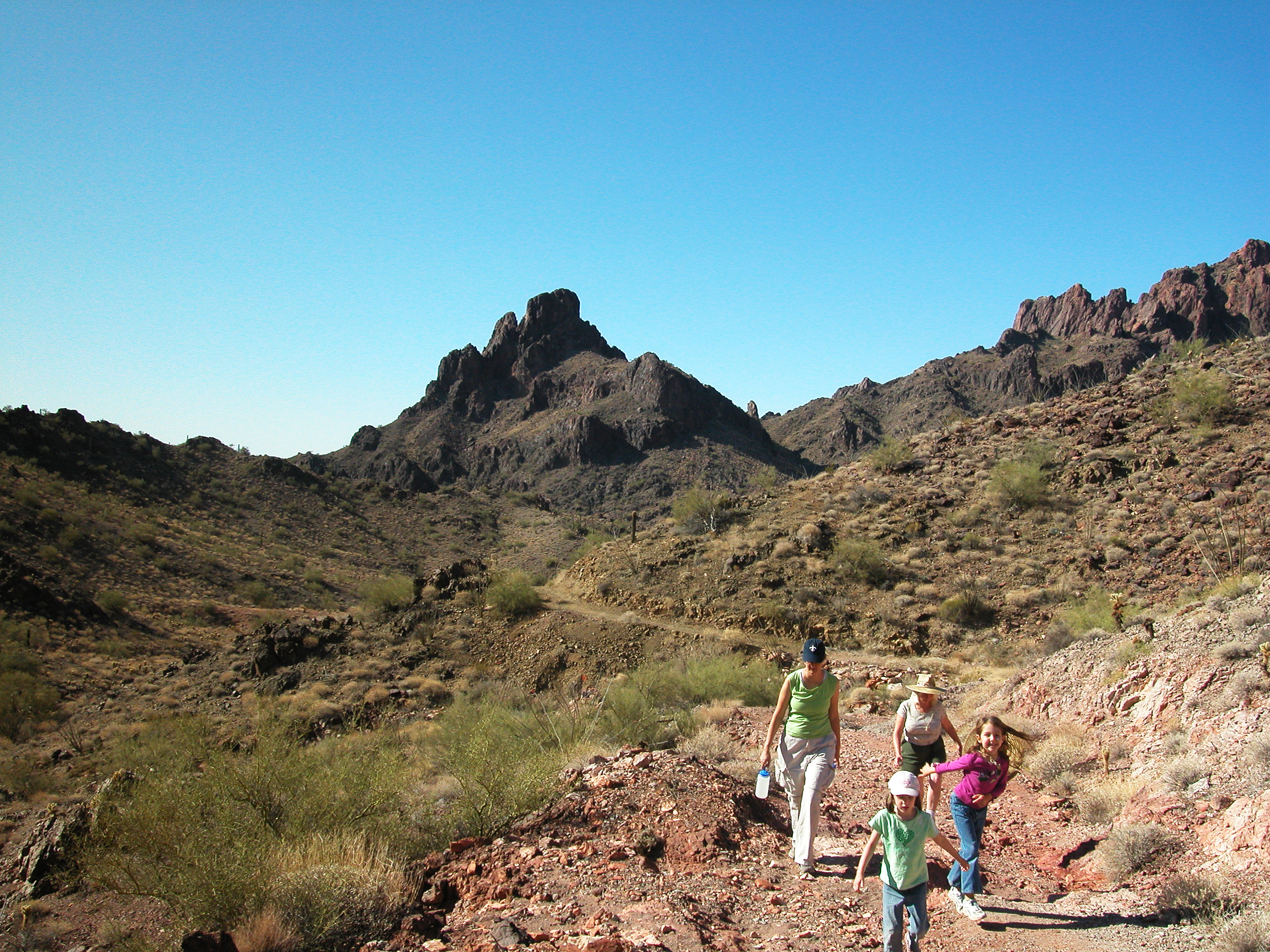
The old mine road continued beyond the closed gate, and it made for a comfortable but steady climb up the west branch of the wash.
As we neared the saddle between two peaks, we noted a quaint feature – a small hole through the hill on the right beneath a heavy arch. I thought maybe this was the eponymous Big Eye, until an old-timer set me straight a few weeks later.
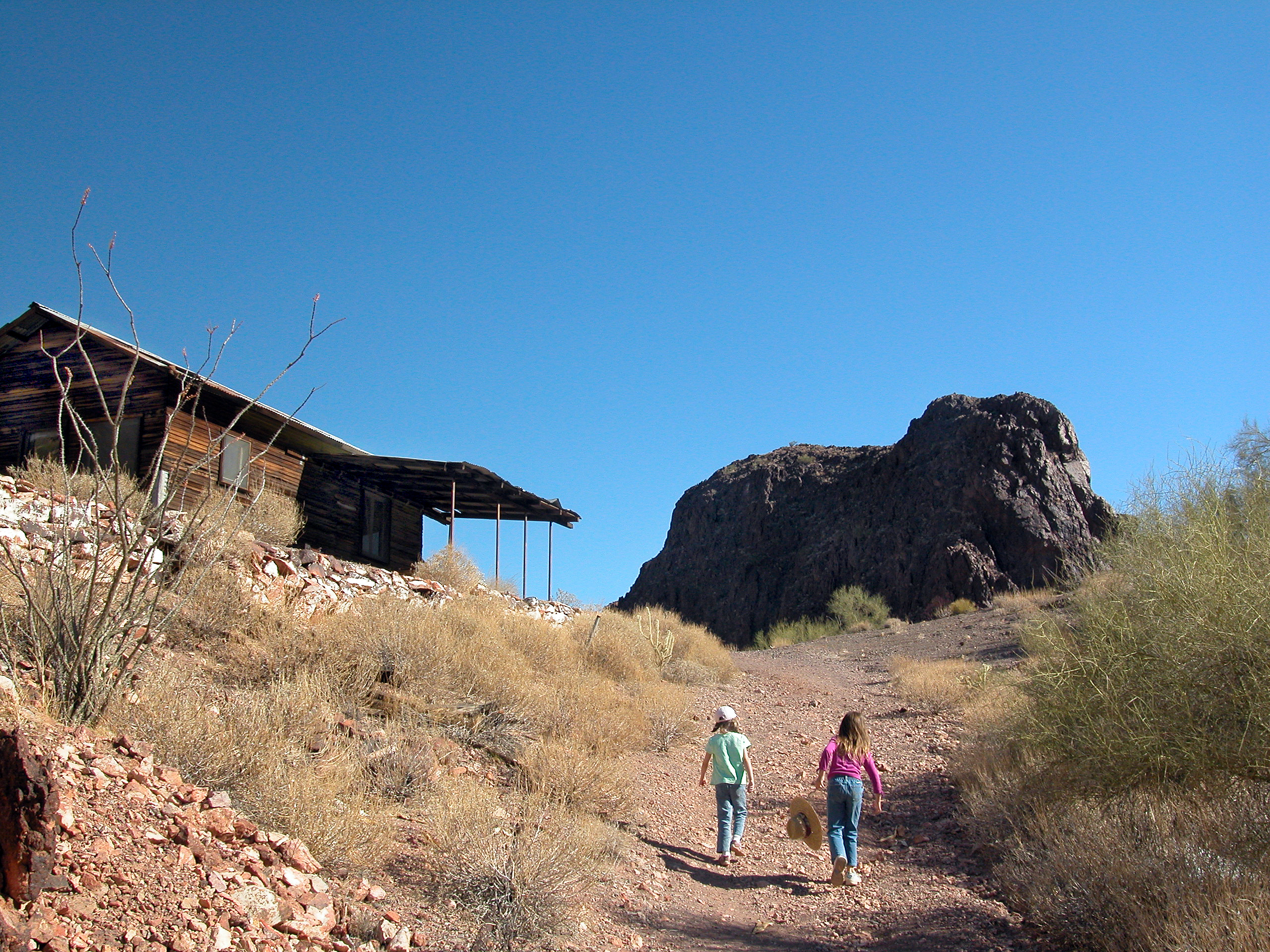
At the top of the road sat a wooden house. It was well maintained, with a corrugated metal roof and a dirt porch, but the scattered outbuildings had pretty much fallen in. The inside was clean and simply furnished – with a couple of hard wooden beds, some kitchen shelves, an old stove and a rough table on which sat the guest log. It was like a shrine to the hardy race of men who had worked out here off and on for the first half of the last century.
At the saddle beyond the house we had a good view to the northwest of the higher peaks in the range. In the narrow draw below nestled the remains of another wooden building and a few twisted lengths of track, surrounded by the rubble from the string of mine shafts on the hillside above.
In place of the hard scramble down, though, we had our sights on the near mountain peak to the left. We followed the trail back up to a concrete cistern that had caught the rare rivulets of precious water from the draw. Then we continued up past the lips of several gaping shafts, being careful to keep a firm grip on the kids.
The trail quickly disappeared. But by now the goal was in sight, and we cheerfully wound our way among the cholla and ocotillo. Indeed, the next saddle opened up to a spectacular view of the plain, with the green squares of Yuma valley farmland in the distance. Even at high noon, the wind was actually cold here at well above 3,000 feet. We huddled in the lee of a natural parapet to enjoy the view and the clean air.
A perfect panorama
After our traditional snack of crackers, cheese, smoked oysters and slices of apple, Lori and I had one more ambition that the others didn’t share – to scramble up the last few hundred yard to the highest point on our mountain, a dark jumble of volcanic slabs farther up the ridge. From there we could see to the edges of the County.

In the distant haze to the south and east lay the parallel mountain spines on the Barry Goldwater bombing range. Due north across King Valley was the massive head of the Kofa range, which tailed off to the east.
All around us lay the impassible ruggedness of the Castle Dome range, and a few miles to the west squatted the titular peak itself. I mused that the mountain’s name really shows its split personality: from the south it looks like a giant fortress, but from the east it really is a dome. And from this side the prominent finger, invisible from Yuma, is in sharp profile.
I don’t know whose idea it was, but we decided to head back to camp along the beeline – that is, down the pathless slope. It seemed logical at the time but, like most desert terrain, this was deceptive from a distance.
Pretty much the whole way we were either hopping down from one boulder to the next, switchbacking across loose shale or else crabwalking down smooth rock faces. I could help my daughter along, who’s only about 50 pounds. But the others were soon far behind, negotiating the bleak landscape an inch at a time. At least one snake was spotted.
Finally, we had to execute a truly technical maneuver when the dry streambed dropped off sharply through a narrow bottleneck. By the time we met up with the mine road, we’d had our exercise for the week.
Back to summer
At the campsite, a colony of bees had found the sweet remnants of our breakfast, and it took half an hour to drive them away. If they had been the Africanized kind – now very common in this area – we might have simply abandoned some of our gear. That would teach us to clean up…
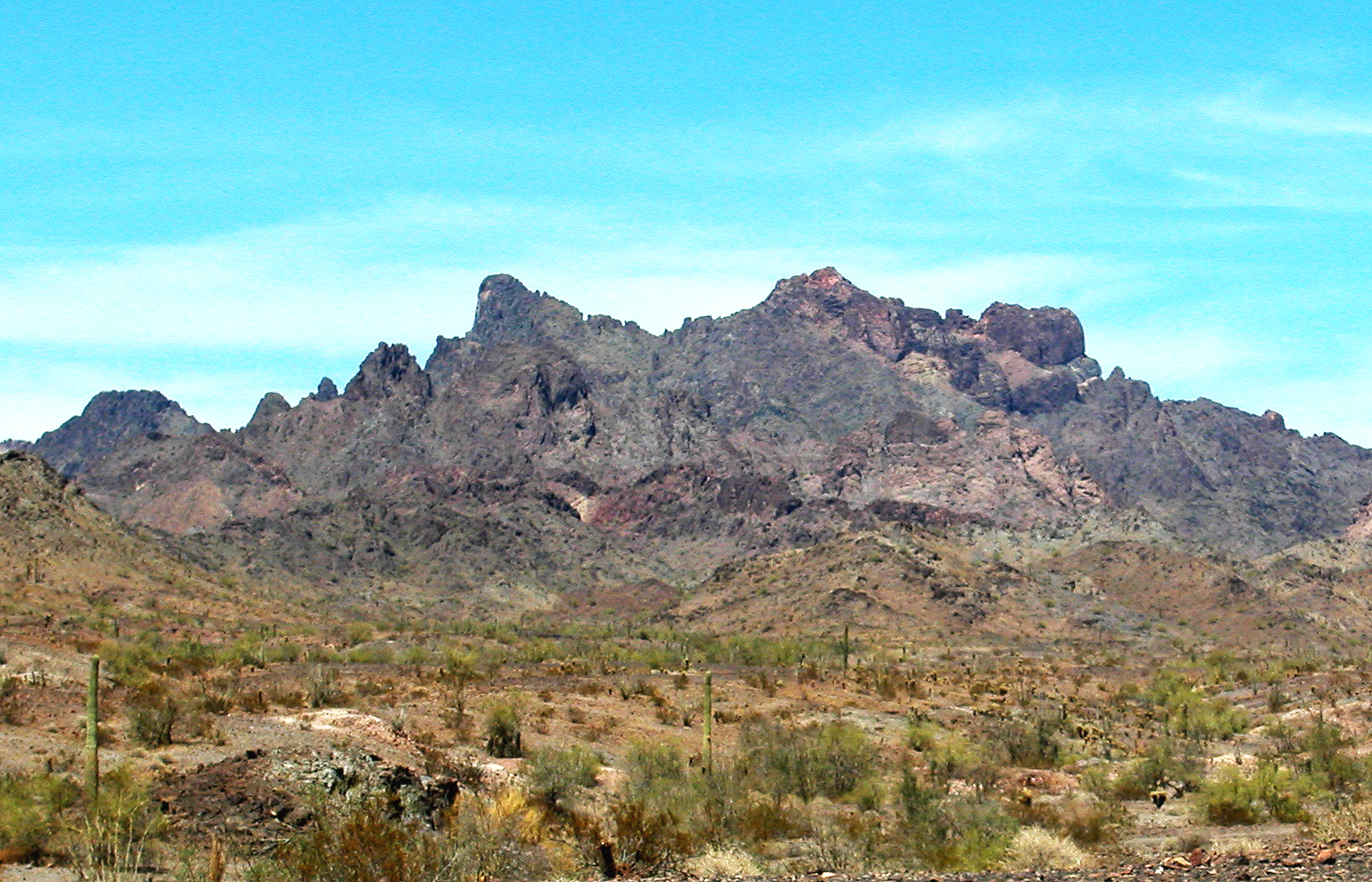
Now that we knew the road out, we could take it a little faster. But the winding and jolting made at least one of us carsick. I had more than one chance during the unscheduled stops to study from various angles the area we had left behind. I wanted to memorize the exact peak we had climbed so that, when I got a clear view from town, I could pick it out along the ragged ridgeline that stretches east from Castle Dome.
This is a remote spot that has something for everyone – the four-wheeler, the hiker, the naturalist, the rock hound, the historian. But for most people it would have to wait a few months. Back here in the open, on the low desert plains and away from the shelter of the hills, it was suddenly hot. Summer had returned.

 Sonoran Visions