This year we fulfilled a long-term dream of hiking Arivaipa Canyon Wilderness.
Named after its early inhabitants, a not-so-fierce tribe of Apaches, it has a colorful history populated by miners, ranchers, hunters and naturalists. Originally designated in 1969 as the first BLM Primitive Area in the U.S., it’s creek is one of only a few that flow year-round in Arizona, and one of the few in the American West that actually traverse a mountain range, the Galiuros.
Over the years, we’ve driven right up to both ends of the canyon – the upper (east) and lower (west) – but never had the required permit to go in. To finally pull off the trip, we had to go against character and plan ahead.
The first problem was finding a three-day weekend when a dozen or so of our interested friends could make it. Everybody had to commit, because reservations are made and pre-paid on line. And they fill up as soon as they open, three months in advance.
The other problem was deciding where to start. The west entrance is an easy 12-mile drive on graded dirt from AZ 77 south of Winkleman, but then it’s a 2-mile hike to the opening of the canyon. The east side is more lush with easier hiking, but access is harder – down from U.S. 70 near Safford, through the village of Klondyke, and over increasingly rugged dirt and even a few creek crossings.
We mulled over the option of leaving a car at one end, then driving around and hiking all the way through. But the shuttle from one trailhead to the other is four hours – multiplied by three in the long run. We finally settled on taking a Yuma group of ten in from the west and meeting up somewhere in the middle with another group of five coming over from Phoenix. We reserved the allowed limit of three days and two nights for this ambitious scheme.
Best-laid plans
Full of optimism, we rendezvoused at 4:00 a.m. on the designated day and caravanned east, then north – through Tucson, Oracle, Mammoth – then east again, among picturesque homesteads nestled along the creek. At the parking lot, we signed in, crossed into the wilderness, and descended to the floodplain.
The rule of thumb: A strong hiker should budget an hour per mile through the 11 miles of canyon, given the weight of the necessary gear and the lack of a maintained trail (hiking is right in the stream most of the time). Of course, a chain is only as strong as its weakest link . . .
Unbeknownst to the rest of us, one of our group, Charlie, recalling his glory days leading school trips, had over-packed and quickly fell behind. At a leisurely pace, we enjoyed those first two miles beneath the giant cottonwoods, flanked by low desert hills.
But, by the time we reached the narrows between the bright cliffs of the canyon proper, it was clear we wouldn’t be going much farther that day. Charlie was painfully picking his way among the river rocks with his twin hiking sticks, he spent most of the time leaning his great slab of gear against the canyon walls, and his skin had taken on a glossy opacity in the dancing light that reflected off the cold stream.
At mid-afternoon, about a mile and a half into the canyon, we stopped to confer at one of the flat areas worn smooth by campers. I scouted ahead, accompanied by Hanna – a seasoned hiker who didn’t even bother to drop her gear, having distilled it down to about 12 pounds. But the next mile upstream was suddenly much wilder, and we had to bound over boulders, crash through shrubs, slog against the current. Everywhere around us were signs of yesterday’s heavy rain; in one place debris was piled ten feet high against the trunk of a tree. Soon all the sunlight had retreated to the heights of the upper walls, a chilly breeze had sprung up, and we still hadn’t sighted the next side canyon.

When we got back to the others, they’d already staked out their tents and started cooking. At the far end of the campsite, Charlie had spread out the contents of his pack – single-burner stoves, gas canisters, flashlights, tents, kitchenware, stools, lots of water, an axe. Sheepishly, he mentioned that he’d weighed it last night at 85 pounds.
Into the shadow of the valley
As expected, most of the group decided to stay put and day-hike from here. But a few of us would have to go ahead to Booger (one of the seven canyons feeding into the main cut) to rendezvous with the Phoenix folks. So three of us struck out mid-morning over the wild stretch. We had gotten better, at least, at finding the faint paths along dry land.
Finally, the narrow slot opened up into a giant arena, where two major canyons came in from either side. We considered climbing up to the famous bat cave in Virgus, to the right. But we had learned to respect the terrain and decided to save our energy for the long return trip tomorrow.
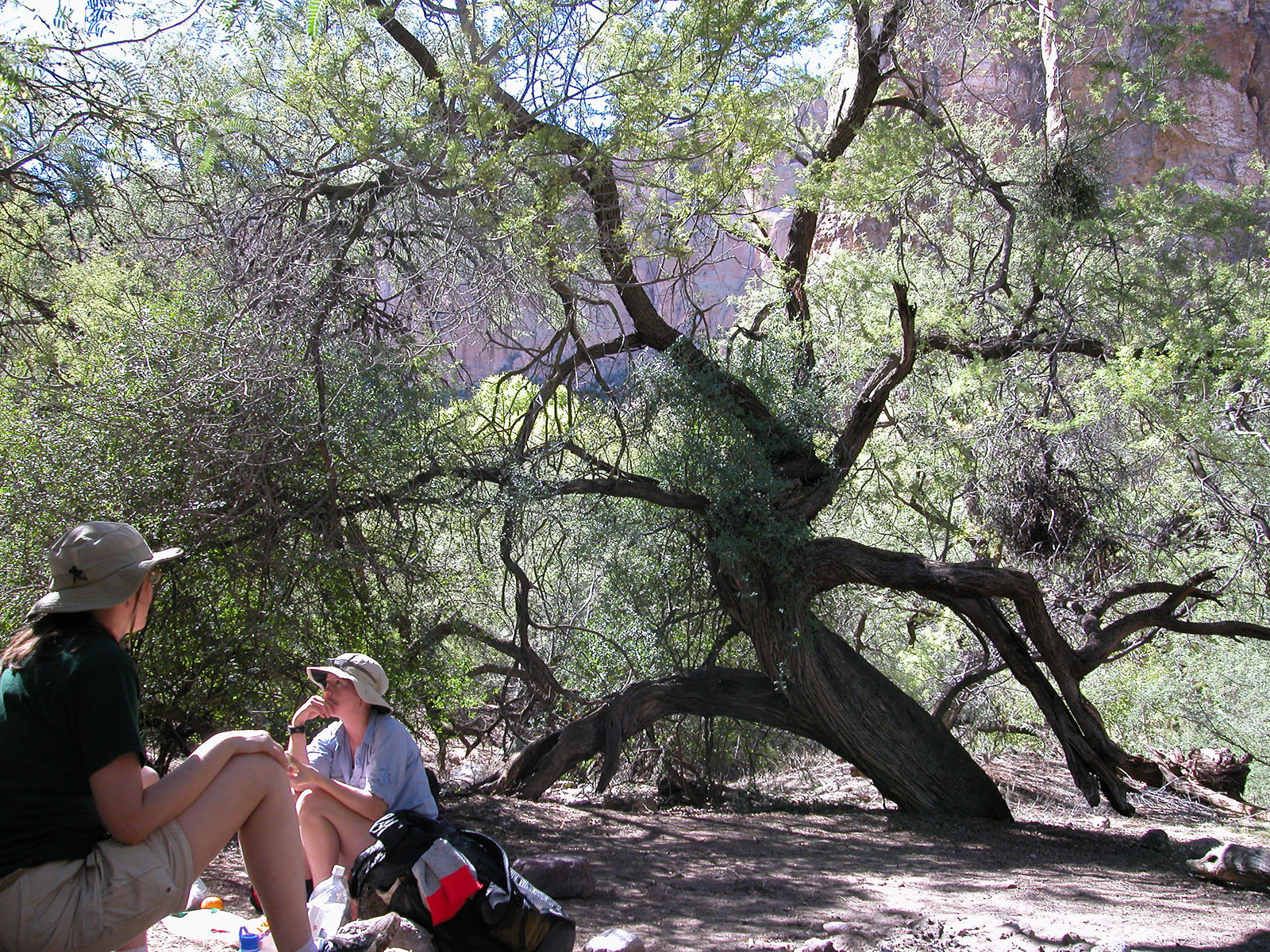
Beyond this central intersection was a forest of gnarled mesquite, and we selected a horizontal trunk to rest. A couple of times we could hear the voices of hikers down by the stream. Here at Horse Camp, the midpoint of the canyon, there’s room for hundreds of campers, though the established wilderness limit is 50 on any given day. Somewhere nearby are the ruins of a cabin.
After our lunch of cheese, crackers and apples, we pushed on and right away overtook some stragglers from a youth outing. One sullen scout was parked right in the middle of the stream, to the dismay of his adult guide.
From here, forward progress was much easier. At this point, probably 400 feet higher than the western trailhead, the creek has not yet begun cutting into the burgundy bedrock. So the upper half of the canyon is wider, flatter, more open; and its blond limestone walls rise much higher – a full 1000 feet above the floor.
In this oasis of biological diversity, where a variety of large mammals depend on the water supply – bighorn sheep, mule deer, black bears – we spotted only a few whitetails. That may have been a red-tail hawk we saw riding the high updrafts, or it might have been one of the threatened peregrine falcons. And, among the myriad birds we saw crowding the canopy of willow, ash and giant sycamore, some must have been belted kingfishers, vermilion flycatchers, rose-throated becards, giant blue herons . . .
Miles from nowhere
We reached Booger in good time. No sign of our Phoenix friends yet, so we had time for a side trip up Booger Canyon, a steep rock jumble that over the eons cascaded down from the distant rim.
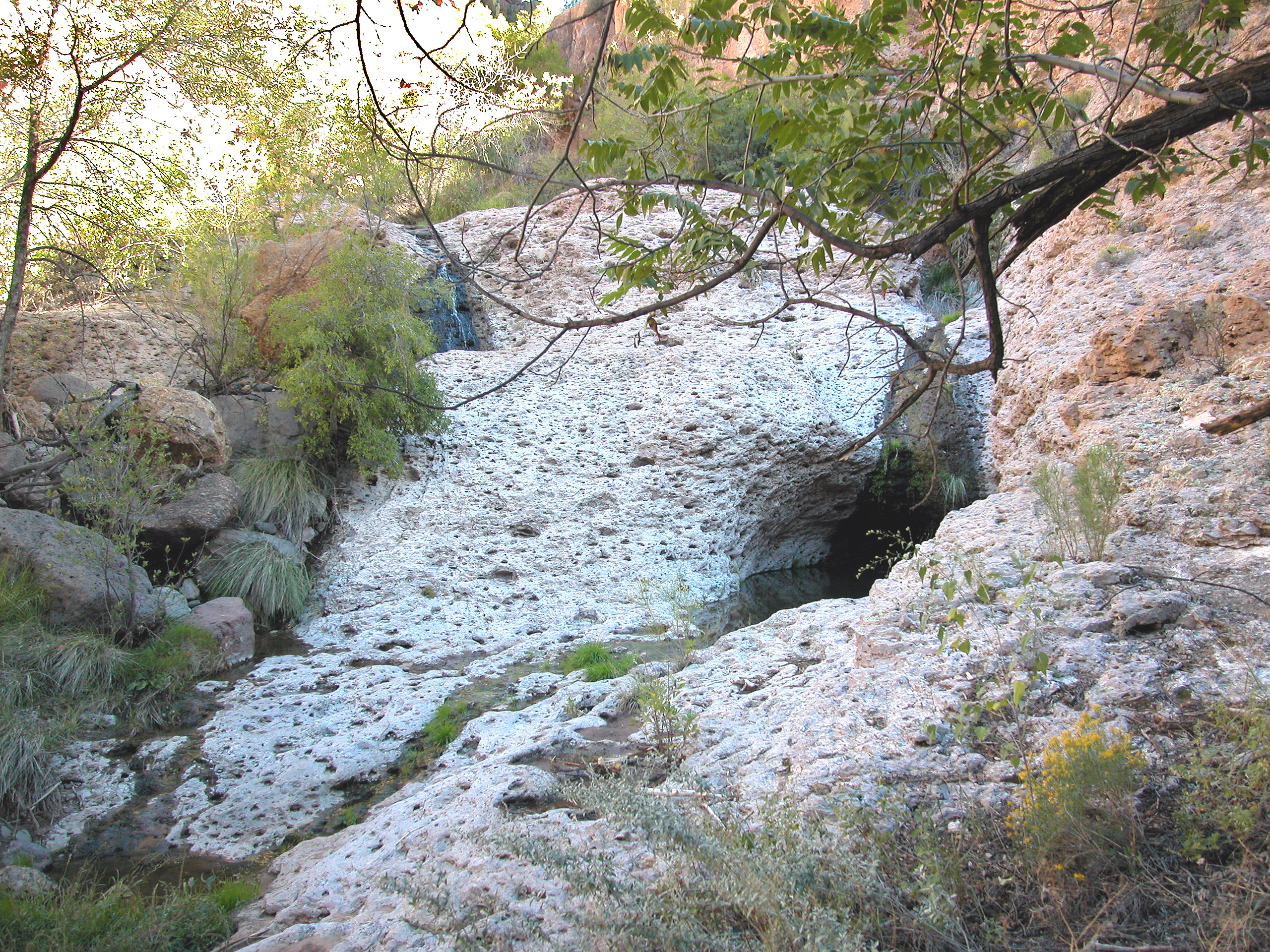
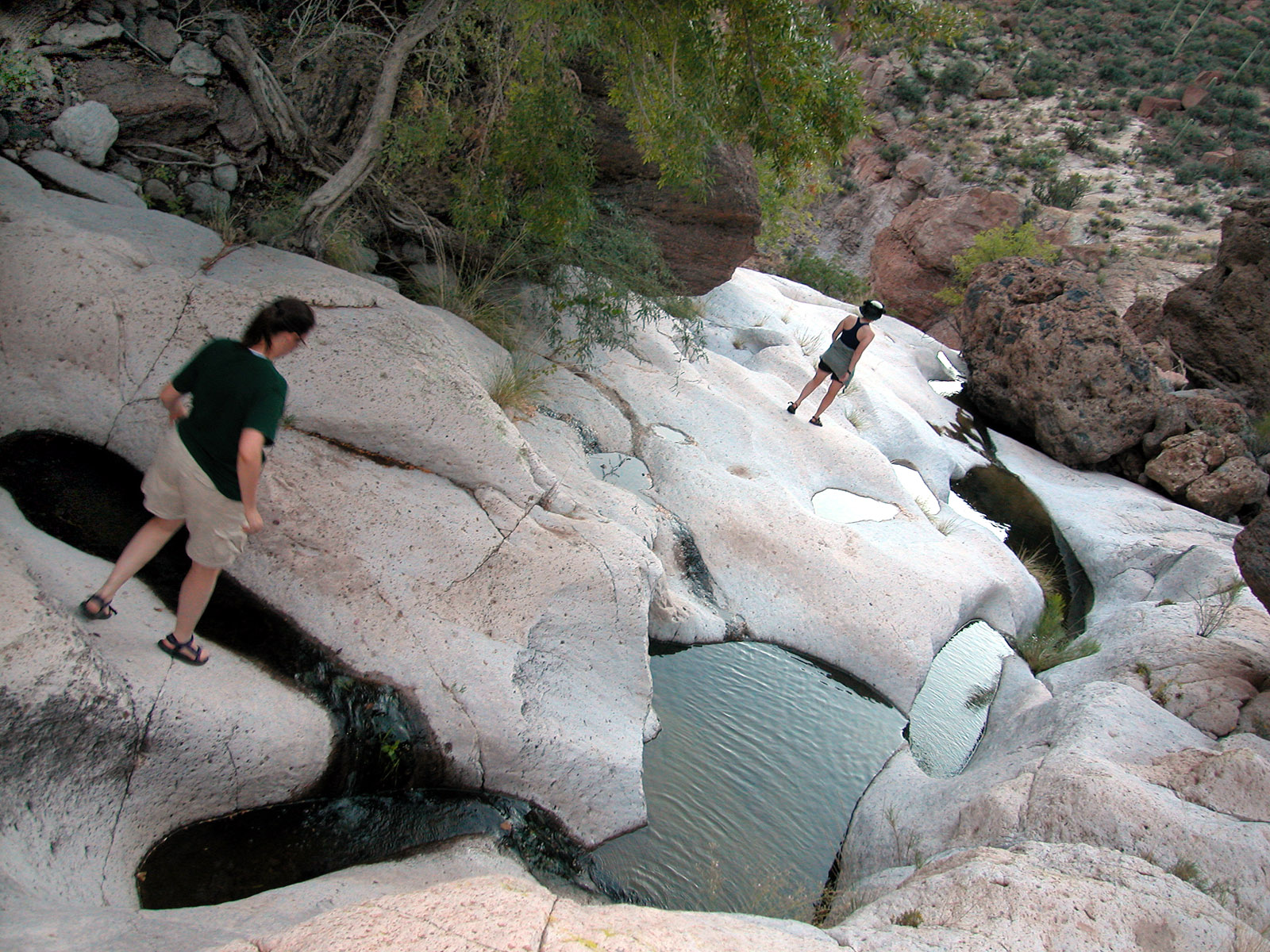
After working our way through the thorn thicket that clogs the canyon’s mouth, we had to be creative in scaling the rock faces worn smooth by flash floods. But the reward was immense. Scattered everywhere on the slope were deep pools, freshly flushed and filled to the brim. We played among the grottoes and gurgling waterfalls until the sunlight flared and died against the far canyon wall and the pregnant moon crept above the saguaro-spiked shoulder.
Our friends never showed up. From our campsite, we thought we heard them calling in the darkness. But it was only a search party – the same group we’d passed in the stream, looking for the pudgy scout, who’d lagged so far behind they lost track of him.
We hoped that all the local mountain lions had been well fed lately, and that the boy was toting his own sleeping bag, because it was a cold night. In fact, our friends (who, it turned out, had decided to just day-hike in from the east trailhead) reported later that they had morning frost at their campsite, just a couple hundred feet higher in elevation.
As for ourselves – we huddled around a low fire, enjoying hours of Irish shanties, jigs and reels that Hanna played on her pennywhistle. Afterwards, it wasn’t easy to say good-night to the crisp moonlight, and to the rarity of a babbling brook only a few yards away.
Downstream
The next day we didn’t slow down much, except to filter drinking water from the stream. We almost passed without noticing our first night’s campsite, well erased by our companions. Once, at mid-afternoon, we cooled off with a dip in one of the deep pools cut by a bend in the stream, no doubt scaring off the native spikedace and leach minnows.

After six hours’ hiking, the last two-mile stretch across the floodplain seemed vastly longer than when we came in. And we wouldn’t have wanted the switchback climb out to the parking lot to be a step longer.
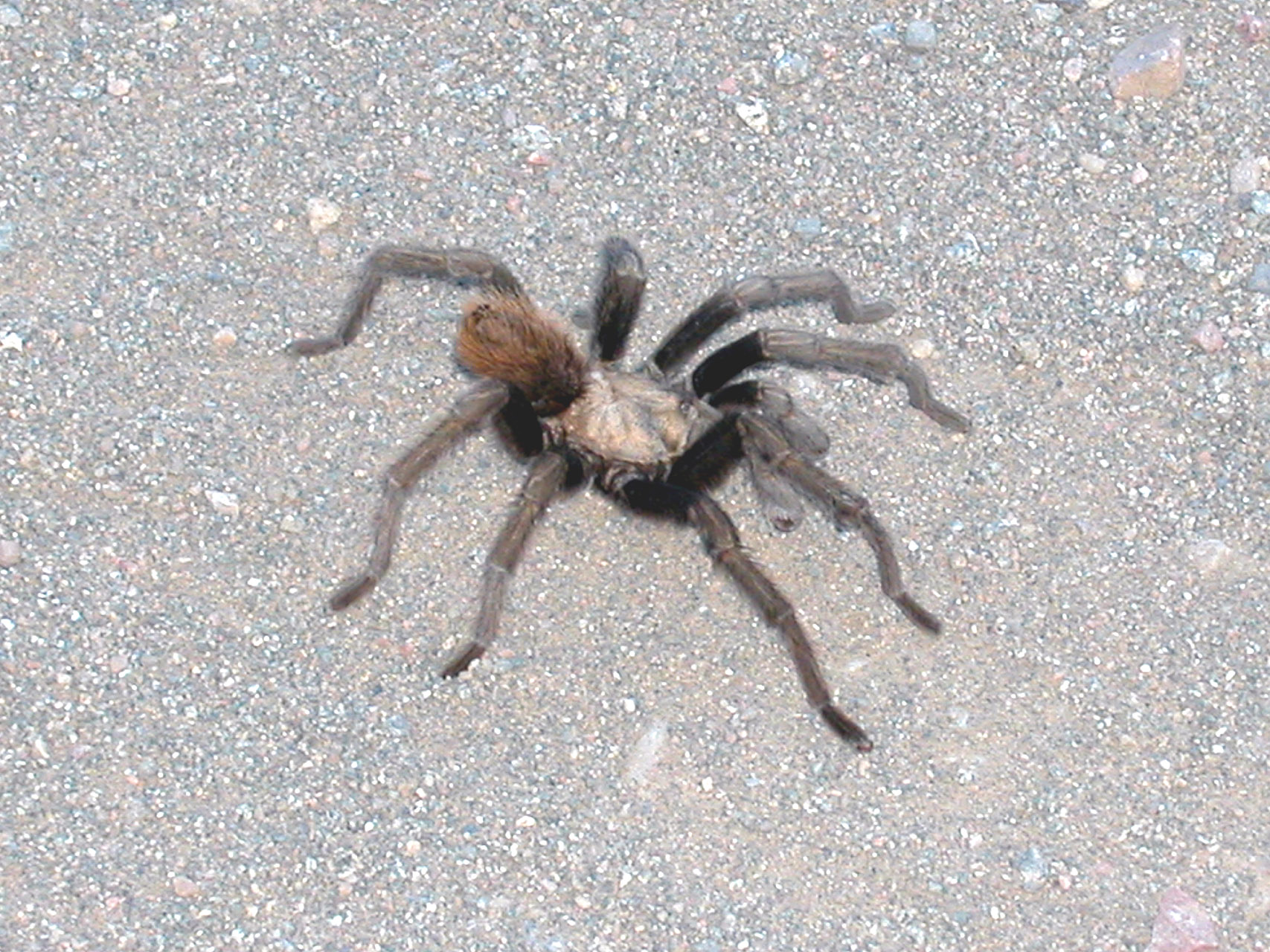
Just as we were heading down the road, a beautiful black and brown tarantula scurried out in front of the car. He wasn’t so cocky, though, when we came snooping up to him. We left him curled up into a little fist.

 Sonoran Visions