The defining phrase of Western expansionism in this country scarcely requires yet another repetition. It was coined (presumably) by a certain East Coast publisher just weeks after the end of the Civil War and played a role in launching an era which, at best, made the continent safe for American values and, at worst, drove an entire race and many animal species to the brink of extinction while setting the stage for a general ecological degradation that can never be reversed.
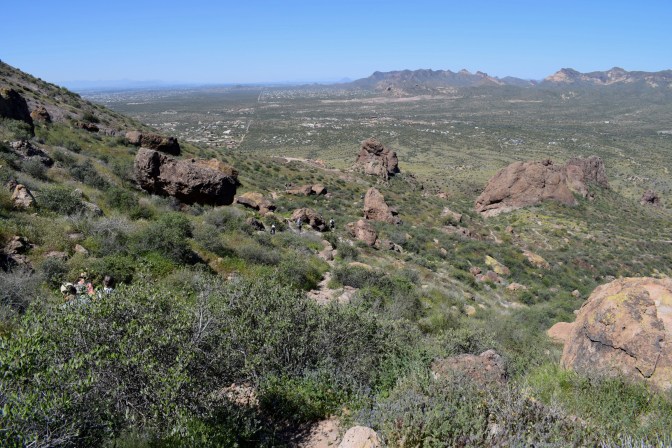
When I answered the call to “Go West” I was 37, not quite the “young man” of the idealized frontier. And I didn’t do it in order to “grow up with the country” but rather to cash in my brand-new Ph.D. on a teaching job smack-dab in the middle of the Sonoran Desert – a far cry from the lush, humid climes I had inhabited up to that point. I had road-tripped across the Continental Divide for the first time a couple of years earlier but was still shocked by the severity of the moonscape that rolled beneath the local puddle-jumper out of Phoenix Sky Harbor.
It was a record-hot fall, with daily highs stuck around 118°F till almost November as I commuted between the irrigated fields to campus, windows down, in my antique Comet. Since the advent of the Territorial Prison, Yuma had been the very symbol of the end-of-the-line last outpost of civilization, and even now it was a sleepy, parochial community, nestled against the international border and a three-hour drive from anywhere you could name. I fully expected to be following so many entry-level employees I had met, taking the revolving door to somewhere normal at first chance.
About a year and a half in, though, something clicked. Maybe it was when someone introduced me to the Sierra Pinacate, a remote region of recent volcanic activity. In those days, crossing the border was a much more casual affair, and the Great Western Drought hadn’t yet kicked in. For someone used to damp cold in winter, flying pests in summer, and the orderly stamp of civilized society in every direction, this was a wild and surreal landscape – the stuff of primal visions.
* * *
From that point on, I was a convert to the church of the Sonoran Desert – the cathedral of its basins and ranges, the congregation of its unique fauna and flora, the scripture of its sights, sounds, and sensations. As much as possible between the ongoing pressures of life – grading student essays, raising children, and tending my garden, literally and figuratively – I headed out away from the madding crowd every chance I got. Eventually, I realized that I had visited most of the general areas within the bioregion, a few of them pretty intensively.
I had not made these explorations systematically or with a goal in mind but rather out of some undefined inner compulsion. Partly, I’m sure it was the otherworldly strangeness of it all. I’m scarcely unique in having that reaction. Countless anonymous travelers, transplants, and fortune-seekers have come and been forever transformed. Even many who have still never been have fallen under the mythical spell of the landscape through regular exposure – from classic Westerns or Roadrunner cartoons – to images of towering cacti and scattered buttes. Just to name a few literary figures from the past couple of generations, Edward Abbey, Mary Austin, and Barbara Kingsolver were all easterners but are now associated mainly with the desert Southwest.
* * *
Of course, like everything else we have labeled for our convenience, the Sonoran Desert is full of contradictions and ambiguities. Even if we could fully agree upon its boundaries, we recognize several subdivisions covering an area of nearly 100,000 square miles – the Lower Colorado River Valley, the Arizona Upland, the Plains of Sonora, the Central Gulf Coast, and so on. We also can subdivide according to biomes – true desert, chaparral, thornscrub, grassland, riparian area, and even pine forests. At least half a dozen separate deserts even can be identified.
Then of course there are the many official legal designations and administrative bodies involving countless private owners and a veritable alphabet soup of government agencies. Much moreso than back East, there are national parks, national forests, national monuments, wildlife refuges, conservation areas, Indian reservations, state trust lands, state parks, military bases, metropolitan jurisdictions, and so on. We could subdivide according to elevation, ethnicity, historical exploration, multiplicity of uses… But you get the point.
Perhaps most importantly, the region is bisected by an international border, with three U.S. states on one side and three Mexican states on the other. So we could – and pretty much have to – talk also about current political issues. Without a doubt, this particular desert means something different to an undocumented migrant than it does to a cattle rancher or a mining executive. In some places, the line in the sand is invisible, in others it is topped by a “big, beautiful wall.” It is the epicenter of international controversy throughout the hemisphere and in fact has drawn the attention of the entire world.
* * *
In short, the Sonoran Desert defies definition. So why even try to pull all these diverse strands together into a single knotted ball of twine? If I have to have a reason, I’ll say it has to do with what writers like to call a Sense of Place. The basic idea is that any artistic expression that doesn’t account for locationand all of its complex elements – terrain, wildlife, weather, culture, history, &c. – is incomplete. Another way of saying this is that the main character of any story is really its setting. (Think of the greatest novelists – Mark Twain, Emily Bronte, William Faulkner, Gabriel Garcia Marquez, Leslie Marmon Silko).
On a philosophical level, it could be that any worldview that doesn’t account for location is deeply flawed. Certainly, there are philosophies and religious systems that privilege a different realm, that dismiss or even scorn the natural world. And such perspectives might well have had their place in advancing civilization. But we are now seeing the limitations of their usefulness and their validity, and the time is long overdue for a new paradigm – or a return to one that’s long-forgotten.
For over a generation now, the voices of concern, then caution, and now alarm about climate change have risen to a roar. It is no longer remotely debatable that we have done irreversible damage to the natural systems that sustain us, and any idea that we can replace them with something functional is delusional, to put it diplomatically. Given the stakes, any political and economic leaders who are still downplaying the problem are the worst kind of criminals (What should be the penalty for murdering a planet?), and our complacency in accepting their assurances is unforgivable.
* * *
Western civilization, for all the amazing discoveries and creature comforts it has brought us, is based upon an attitude of domination over rather than harmony with nature, and as such it is no longer adequate to address the problems it has created. One of its outgrowths is that we understand less and less how we are part of the natural order; we believe that the world around us is a network of resources for our convenience rather than a recombination of the same stardust of which we ourselves are formed. Just maybe, if we could discipline ourselves to recognize the place where we are at the moment as a living, breathing organism, we might be compelled to nurture rather than abuse it.
Of course, I can’t pretend to be blameless in having made my own contribution to the dire predicament we’re in. And I certainly can’t claim to have the magic bullet for fixing it. We may even be past the tipping point already, but that can’t stop us from trying. (As I once heard Ken Kesey say, “I believe the world is going end, I just don’t act like it anymore.”) My own couple of coppers on the subject is that each of us resolve to embrace that small sliver of creation within our immediate grasp and make our mission in life to ensure that it isn’t degraded any further. For me, that place just happens to be the Sonoran Desert.
Honestly, I don’t understand why we wouldn’t all want to connect with the rest of creation, even if in some alternate reality it were not threatened with extinction. At this point, we just don’t have any other choice.

 Sonoran Visions